S2C 303 · PRACTITIONER PROCESS MAP
How does Service to Cash execute in SAP?
A practitioner-provided view of Service-to-Cash execution from quotation and sales order through customer parts, manufacturing requirements, service performance, delivery, goods issue, billing, accounts receivable, and accounting postings.
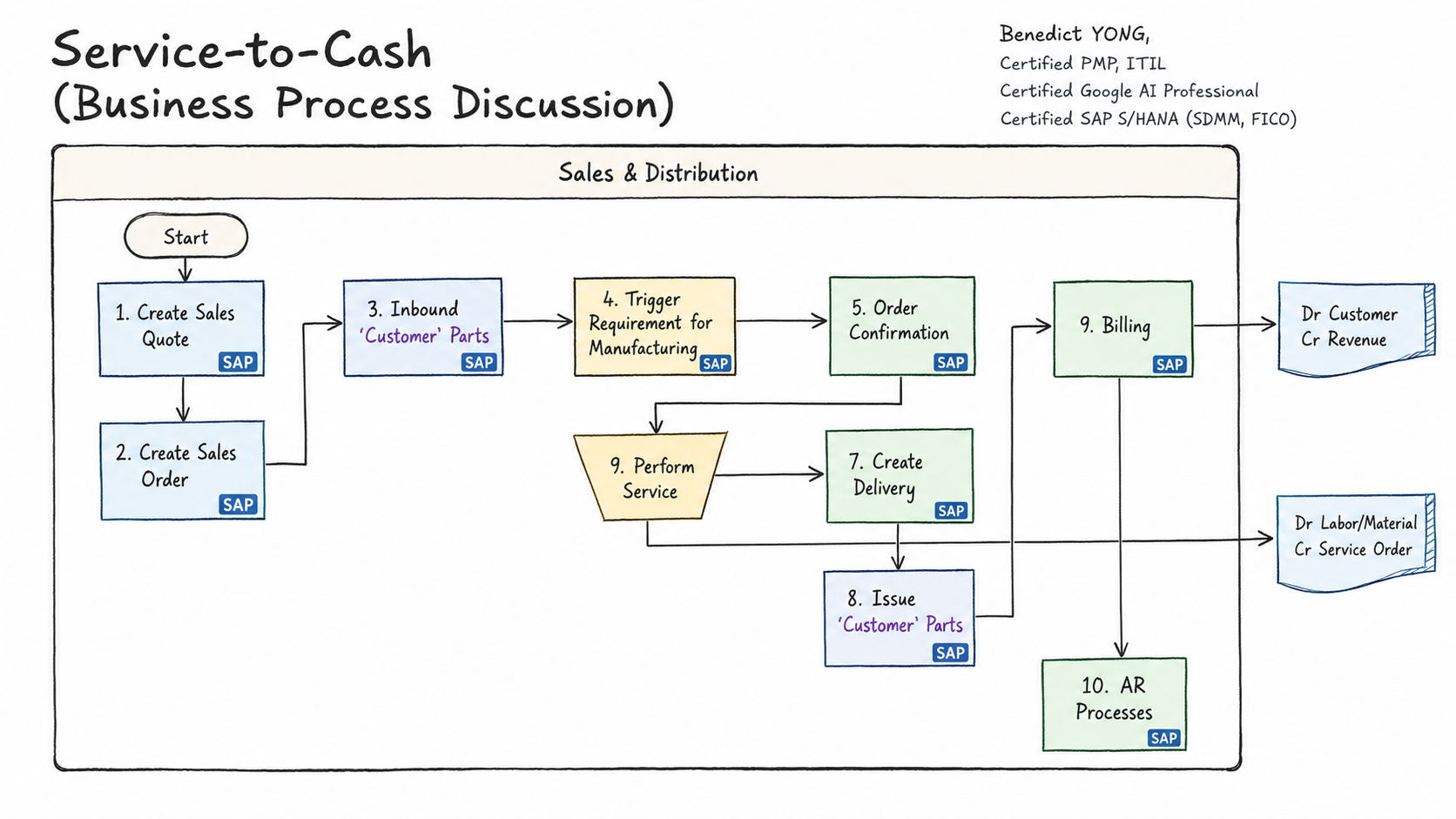
READ THE DIAGRAM
From service request to commercial closure
Read the diagram as one service promise: qualify the need, plan the work, perform and confirm it, then apply the appropriate commercial outcome.
- 01
Create the sales quotation
Where pre-sales evidence is needed, record the proposed service, customer, quantity, date, price, validity, and commercial terms. Confirm the quote is traceable to the customer request and the intended service scope; it is an offer, not yet the binding commitment or executable service demand.
- 02
Create the sales order
Create the binding customer commitment with the correct sold-to and ship-to parties, service item, quantity, requested date, pricing, tax, payment terms, and schedule-line behavior. Check the order captures the commercial reference that must remain connected to customer parts, service execution, delivery, and billing.
- 03
Receive inbound customer parts
Receive customer-owned parts or equipment into controlled custody when the service model requires it. Validate customer ownership, serial or batch identity, condition, quantity, location, receipt evidence, and responsibility; customer material must remain distinguishable from company inventory throughout service execution and return.
- 04
Trigger the manufacturing requirement
Use the accepted service demand to trigger the manufacturing or repair requirement when supply or work must be created. Confirm material or configuration, quantity, date, plant, requirement type, component need, and planning status; the successor order must preserve its relationship to the originating customer service commitment.
- 05
Confirm the order
Confirm the quantity and date that the service and supply path can genuinely support. Compare requested and confirmed schedule lines, available capacity, parts, manufacturing dependencies, and exceptions; communicate the feasible promise only when its execution evidence supports the customer commitment.
- 06
Perform the service
Perform the approved repair, manufacturing, or service work and record labor, materials, findings, measurements, tests, expenses, and completion status. Validate technician or work-center activity, customer-part ownership, safety and quality evidence, and confirmation approval; these facts establish actual service cost and delivered work.
- 07
Create the delivery
Create the delivery when the completed customer parts or service output are due for return or shipping. Check delivery relevance, customer-part assignment, quantity, shipping point, blocks, predecessor status, and pack or hand-off evidence; the delivery organizes the controlled return to the customer.
- 08
Issue the customer parts
Post goods issue when the return or shipment evidence is complete. Validate the customer-part identity, serial continuity, quantity, delivery status, movement, and reversal behavior; this proves the physical return and updates document flow without confusing customer-owned material with company stock.
- 09
Create billing
Create billing from completed commercial and service evidence using the confirmed entitlement, warranty, contract, or chargeable treatment. Validate billed quantity, price, tax, payer, output, and posting status; billing creates the receivable and revenue where applicable, so blocks and pricing differences need explicit ownership.
- 10
Manage Accounts Receivable
Manage the service invoice as an open item until payment is identified and cleared. Monitor due date, payment reference, deductions, disputes, partial or residual items, and collection status; the commercial chain is complete only when the receivable outcome remains explainable and linked to the originating service order.
READ THE PROCESS
The source diagram shows one valid branch
The supplied flow is an in-house service scenario: the customer's equipment or component enters the service centre, may trigger internal supply or manufacturing, is repaired, and is returned. Field service shares the commercial spine but reverses the physical movement.
Establish who, what, and what is owed
Identify the customer, service location, technical object, issue, priority, warranty, contract, SLA, and responsible service organization before making a promise.
Make the work executable and commercially clear
Diagnosis, quotation, approval, skills, parts, dates, safety, access, coverage, and charging basis define the service commitment.
Move the equipment or move the service resources
Depot service controls receipt, custody, workshop repair, testing, and return. Field service controls dispatch, travel, site work, technician stock, acceptance, and possible repeat visits.
Separate technical completion from commercial completion
Confirmed labour, parts, travel, expenses, findings, and acceptance support warranty, contract, fixed-price, or resource-related billing before receivable and cash closure.
THE CRITICAL BRANCH
Where the work happens changes the middle
Both paths begin with the same customer need and entitlement decision, but the direction of movement changes the evidence, planning, inventory handling, acceptance, and common exceptions.
COMMON SERVICE SPINE
Three foundations must survive either branch
The execution location changes, but technical identity, entitlement, and delivered-service evidence remain the basis for a defensible outcome.
Customer and technical object
Keep the customer, site, equipment, serial number, installed base, and service history connected.
Explore service requestsENTITLEMENTWarranty, contract, and SLA
Determine what is owed, what is chargeable, which dates apply, and who owns the commitment.
Explore service planningEVIDENCEConfirmation and acceptance
Record actual work, materials, expenses, findings, completion, and customer acceptance at the source.
Explore executionACCOUNTING HAND-OFFS
Cost, revenue, and cash are different events
Technical completion does not by itself prove billing eligibility. Inventory consumption, service-order cost, customer invoicing, and payment each require their own evidence.
Company-owned spare parts leave stock and become service-delivery cost; customer-owned material remains separately identified.
Commercially complete service creates the customer invoice according to entitlement and billing rules.
The receipt settles the service invoice when the payment is identified and cleared.
PRACTITIONER VIEW
What to watch across both paths
Follow identity, entitlement, physical custody, confirmed resources, acceptance, and commercial status rather than only the happy-path documents.
Customer and technical identity
Sold-to party, service recipient, site, equipment, functional location, installed base, serial number, history, and responsible service organization.
Entitlement and promise
Warranty, contract, SLA, priority, response date, completion date, quotation approval, coverage, exclusions, and chargeability.
Execution-model decision
Remote resolution, field visit, or depot repair; custody of customer equipment; skills, location, capacity, parts, safety, and access.
Delivered-service evidence
Diagnosis, operations, labour, parts, travel, expenses, measurements, completion code, customer acceptance, and follow-up requirement.
Inventory and logistics integrity
Customer-owned material, warehouse or technician stock, parts issue and return, serial continuity, repaired-equipment return, and unused material.
Commercial and financial closure
Contract consumption, warranty responsibility, billing relevance, price basis, tax, revenue, cost, margin, receivable, payment, and clearing.
WHEN THE CHAIN BREAKS
Start with the missing service evidence
The blocked successor is usually a symptom. Locate whether identity, entitlement, execution, acceptance, or chargeability first became incomplete.
Is the service commitment complete?
Check technical-object identity, service organization, priority, contract or warranty, SLA dates, quotation approval, operations, skills, parts, safety, and release status.
What execution evidence is missing?
For depot work, check custody, diagnosis, components, testing, and return readiness. For field work, check dispatch, access, time, parts, signature, and follow-up status.
Is the order commercially complete?
Check confirmation approval, acceptance, contract consumption, warranty coverage, billing relevance, dynamic item data, price, tax, rejection, and billing block.
Connect the practitioner flow to the configuration decisions, dependencies, transport boundaries, and end-to-end proof required to make it work.