ICS · EXECUTION MAP
How does Branch sell while Affiliated Supply supplies?
The Branch owns the customer sale. Affiliated Supply supplies and ships the goods directly to the customer. SAP connects the customer order, purchasing demand, supplier fulfilment, intercompany charge, customer billing, and accounting evidence.
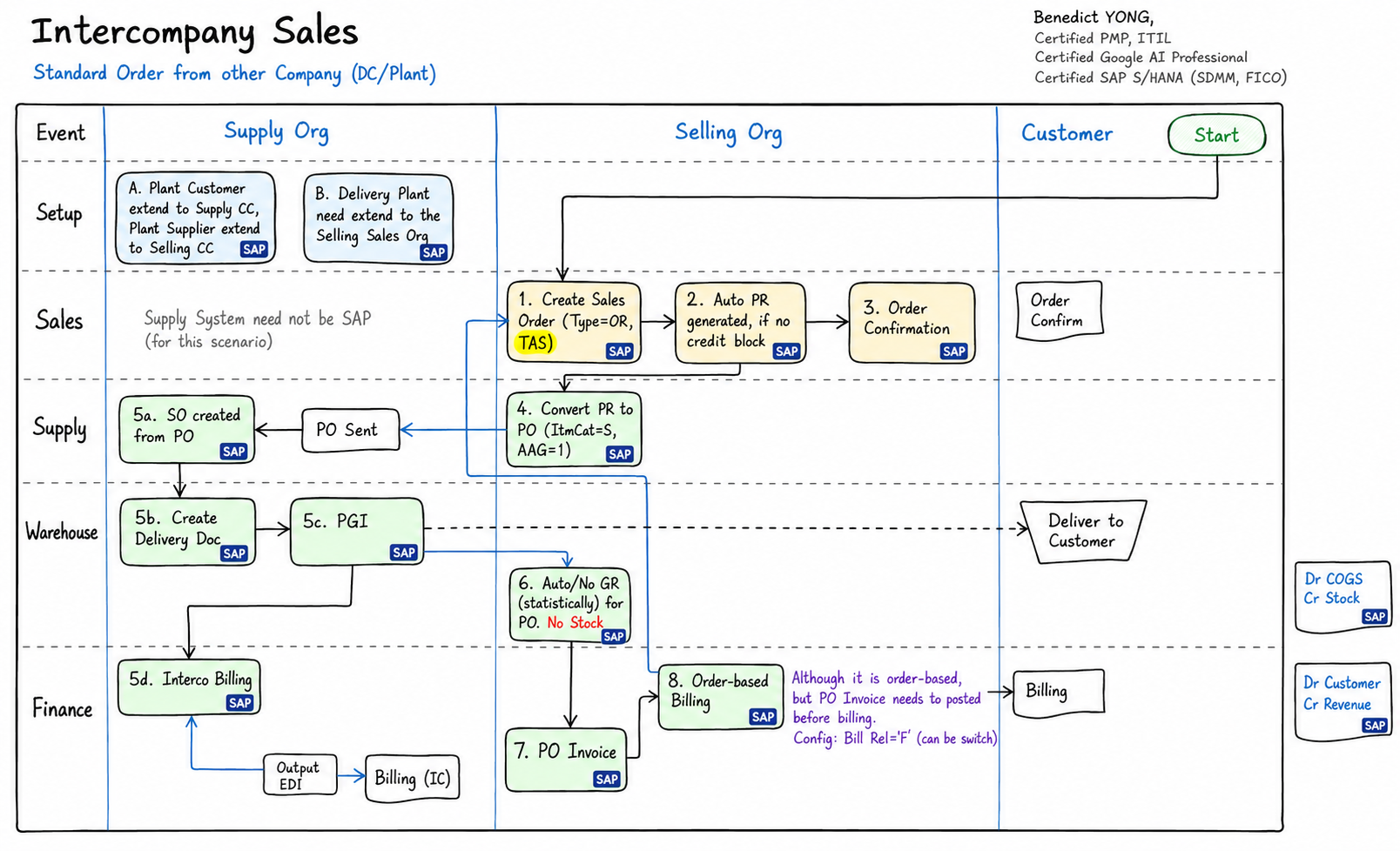
READ THE DIAGRAM
From customer order to both company postings
Read the swimlanes in sequence. Setup creates the cross-company roles; Branch owns the external sale; Affiliated Supply fulfils it; the internal invoice and customer invoice close the two financial sides.
- A
Extend the plant customer to the supply company
Setup makes the selling company available as the internal customer in the Affiliated Supply. This establishes the receiving party for the supplying company’s internal sales and billing documents.
Creates A valid internal customer and billing relationship in Affiliated Supply.
- B
Extend the delivering plant to the selling sales area
The Affiliated Supply delivering plant must be valid for the Branch selling organisation. This lets the external sales order source direct delivery from the supplying company while keeping Branch as the customer-facing seller.
Creates A permitted direct-delivery source for the Branch sales item.
- 01
Create the Branch customer sales order
Branch records the customer commitment using the illustrated intercompany item category. It establishes the external customer, product, quantity, price, delivery promise, and commercial ownership of the sale.
Creates The external demand and the source reference for every downstream document.
- 02
Generate the purchase requisition
The sales order creates purchasing demand for supply from Affiliated Supply when the credit and sourcing conditions permit. The PR is the control hand-off from Branch sales to Branch purchasing, not a physical receipt plan.
Creates A purchasing work item that preserves the required quantity, date, supplier, and customer destination.
- 03
Confirm the external order
Order confirmation communicates the customer promise once the sales and supply conditions are acceptable. Its dates must remain aligned with the later procurement and delivery chain.
Creates A customer commitment that can be compared with the eventual Affiliated Supply confirmation and shipment.
- 04
Convert the PR to an intercompany purchase order
Branch purchasing converts the requisition into the PO sent to Affiliated Supply. The PO carries the commercial demand that enables HQ to create its corresponding internal supply order.
Creates The formal internal purchase commitment and the reference for Branch invoice verification.
- 5a
Create the Affiliated Supply sales order from the PO
Affiliated Supply receives the PO and creates the supplying-company sales order. This is the internal order that links Branch's procurement evidence to HQ’s delivery, goods issue, and intercompany billing.
Creates HQ’s executable supply commitment with a traceable Branch PO reference.
- 5b
Create the delivery document
Affiliated Supply creates the delivery against its internal sales order and prepares the goods for direct shipment. The delivery identifies the actual supplying plant, shipping evidence, and customer destination.
Creates The operational record for picking, loading, shipment, and proof of delivery.
- 5c
Post goods issue and ship directly to the customer
HQ posts goods issue, reducing its inventory and recording its physical fulfilment evidence. The goods go directly to the customer; Branch does not receive the goods into its own stock in this scenario.
Creates Inventory and COGS evidence in HQ, plus the physical fulfilment trigger for settlement.
- 5d
Create intercompany billing
HQ bills Branch for the supply. The intercompany billing document and its output or EDI hand-off provide the commercial evidence for the internal charge and Branch's payable.
Creates HQ’s intercompany receivable and the invoice reference Branch must match to its PO.
- 06
Handle the purchase-order goods-receipt status
The illustrated design shows an automatic or statistical PO receipt with no Branch stock movement. Confirm the configured receipt treatment so procurement status supports invoice processing without falsely representing a physical warehouse receipt.
Creates Procurement progress evidence without inventing Branch inventory.
- 07
Post the Affiliated Supply PO invoice
Branch posts the internal supplier invoice against its PO. This creates the intercompany payable and records the designed purchase cost, cost of goods sold, or clearing impact before customer billing is released.
Creates Branch's payable and the settlement evidence used by the illustrated billing control.
- 08
Create order-based customer billing
Branch invoices the external customer from its sales order. This completes the customer-facing revenue and receivable side; reconcile it to HQ’s intercompany charge, delivery, and goods-issue evidence rather than treating the two invoices as unrelated events.
Creates Branch's customer receivable, revenue, tax, and the final external-side reconciliation record.
THE THREE-PARTY MODEL
Keep commercial ownership, physical supply, and internal settlement separate
The process is easiest to understand when each organisation’s responsibility is stated explicitly.
Branch owns the customer sale
Creates the customer order and purchase order, receives the Affiliated Supply invoice, invoices the customer, recognises customer revenue, and carries the customer receivable.
Affiliated Supply owns fulfilment
Accepts the internal order, supplies the goods, creates the delivery, posts goods issue, ships directly to the customer, and bills the Branch.
The customer buys from Branch
Places the order with Branch, receives the goods from Affiliated Supply, receives the commercial invoice from Branch, and pays Branch.
DOCUMENT CHAIN
Follow both sides of the transaction
The blue hand-offs in the diagram cross organisational boundaries. Each hand-off should leave a traceable reference, status, value, and owner.
ACCOUNTING HAND-OFFS
Two companies recognise different sides of the same fulfilment
The exact tax and account postings depend on the legal design, but the practitioner must reconcile the internal supplier charge with the external customer sale.
Affiliated Supply records that its inventory left for the external customer.
The internal invoice records what Branch owes Affiliated Supply. The exact expense, stock, or clearing design must match the approved accounting model.
Branch recognises the customer-facing sale and creates the customer open item.
PRACTITIONER VIEW
What to watch across the chain
This scenario succeeds only when sales, purchasing, supply, billing, and Finance agree on the same organisational and document relationships.
Partner readiness
Affiliated Supply extension in Branch, Branch internal-customer extension in Affiliated Supply, purchasing and company-code data, sales-area data, payment terms, currencies, and tax identifiers.
Plant and material readiness
Delivering plant extension to the Branch sales organisation, material sales and purchasing views, delivering-plant determination, shipping data, and source-of-supply validity.
Sales-to-purchasing trigger
Order type OR, TAS item-category determination, schedule-line behaviour, PR creation, credit status, purchase requisition linkage, and PO conversion.
Cross-company fulfilment
PO output or EDI, Affiliated Supply sales-order creation, confirmed dates, delivery, PGI, proof of shipment, and direct customer ship-to details.
Invoice dependency
Affiliated Supply intercompany invoice, EDI or invoice receipt, PO invoice verification, quantity and price matching, billing relevance F, and customer billing release.
Financial reconciliation
Intercompany payable and receivable agreement, transfer price, customer revenue, purchase cost, currency differences, tax treatment, billing output, and document references.
WHEN THE CHAIN BREAKS
Find the last successful cross-company hand-off
Do not treat the process as one long transaction. Identify whether the failure occurred in demand transfer, supply execution, invoice exchange, or billing release.
Did the sales item trigger external procurement?
Check item category TAS, schedule-line determination, material and plant data, source-of-supply settings, incompletion, rejection, and credit-block behaviour.
Did the purchase order reach the supply process?
Check PO creation and release, output or EDI status, supplier and internal-customer mapping, sales-area extension, material mapping, dates, blocks, and interface logs.
Was the supplier invoice posted and linked?
Check Affiliated Supply billing output, invoice receipt, PO invoice verification, billing relevance F, billing due status, copy control, pricing, tax, and accounting-block messages.
Translate the practitioner chain into the Business Partner, plant, material, item-category, purchasing, output, billing, tax, and accounting configuration required to make it work.