H2R 303 · PRACTITIONER PROCESS MAP
How does H2R run across HR and payroll?
A practitioner-provided view of the Hire-to-Retire process across SuccessFactors, SAP HCM, payroll, and Finance.
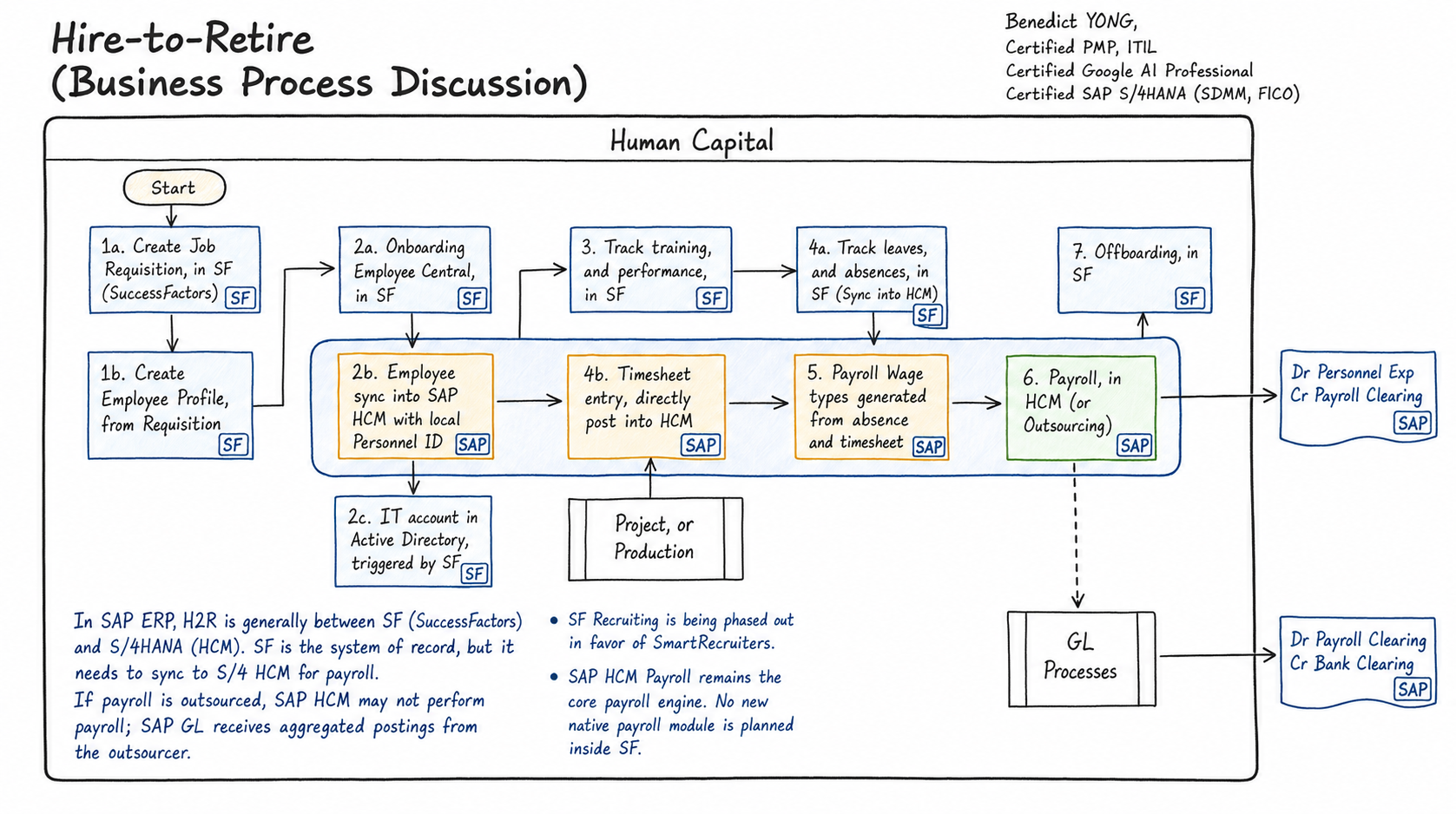
READ THE DIAGRAM
From workforce need to controlled exit
Read H2R as approved employee-state changes. Each step establishes evidence that lets the next team act safely, from workforce demand to final pay and offboarding.
- 01
Define and approve the workforce need
Establish why a role may be filled by confirming the organisation, position, manager, location, cost ownership, workforce plan, and approval. Check that the position or requisition is valid and funded; the approved need is the evidence that authorizes recruiting, not merely a manager request.
- 02
Recruit and accept the candidate
Create the controlled hiring decision through the requisition, candidate record, assessment, offer, and acceptance. Validate candidate identity, approved terms, hiring manager, start date, and any required checks; unresolved approval, offer, or data-quality issue must be resolved before an employment record is created.
- 03
Onboard the worker and maintain employment data
Create the effective-dated worker record with personal, employment, job, compensation, location, access, and payroll-relevant data. Confirm the correct identifier, event reason, effective date, legal entity, manager, and pay eligibility, because these values drive downstream permissions, integrations, and payroll population.
- 04
Capture approved time and people changes
Record approved time, absence, compensation changes, benefits, deductions, and other people events for the intended payroll period. Check completeness, effective date, workflow status, cut-off, valuation, and rejected interface records; late or unapproved changes require an explicit correction or retroactive-treatment path.
- 05
Calculate, pay, and post payroll
Validate the payroll population and inputs, calculate employee results, obtain required approval, produce payments, and post reconciled cost to Finance. Review exceptions, control totals, payment files, bank response, posting status, and reconciliation evidence; distinguish a correct calculation from a completed payment and accounting hand-off.
- 06
Complete offboarding and retain evidence
Close the employment lifecycle with final pay, benefits closure, access removal, asset return, legal retention, and named accountable owners. Confirm the termination date and reason, final payroll result, outstanding obligations, access-deprovisioning evidence, and exception disposition so the former worker is neither overpaid nor left with inappropriate access.
READ THE PROCESS
What the diagram is really saying
H2R is a chain of controlled state changes. A workforce need becomes a worker record, approved changes become payroll inputs, and payroll becomes reconciled Finance evidence without exposing unnecessary people data.
Establish legitimate workforce demand
Position, manager, organisation, cost ownership, requisition, candidate, offer, and approval explain why a person is being hired.
Create an effective-dated worker record
Onboarding, job, compensation, location, permissions, and later changes retain the correct identifier, event reason, and effective date.
Turn approved facts into one payroll result
Time, absence, recurring pay, deductions, and statutory rules enter a defined pay period with visible cut-off and exception ownership.
Close the financial and operational lifecycle
Payroll postings reconcile to Finance; final pay, access removal, asset return, and retention actions complete a controlled exit.
PRACTITIONER CONTROL STACK
Three models explain most H2R outcomes
When the lifecycle looks correct but a transaction behaves unexpectedly, separate workforce structure, employee data ownership, and pay or exit evidence.
Where work belongs
Position, organisation, manager, location, job and cost ownership.
Open workforce structureEMPLOYEE DATAWhich object owns the value
Person, employment, dated Job and Compensation Information, platform user and payroll identity.
Open employee anatomyEXTENSIBILITYHow custom business data is controlled
Object definitions, associations, effective dates, rules, workflow, RBP, UI and OData.
Open MDF deep diveLANDSCAPE VARIANTS
The lifecycle is stable; system ownership varies
The worker lifecycle remains one governed process, but the system boundary varies. Core HR, time, payroll, identity, Finance, and external providers may be separate platforms connected through controlled interfaces.
FINANCIAL HAND-OFFS
Payroll result, payment, posting, and exit are different events
Do not describe payroll as one black box. Calculation proves employee results; payment settles obligations; posting records cost; offboarding closes remaining responsibilities.
Approved payroll results become expenses and employee, tax, benefit, and other liabilities.
Employee and third-party payments settle the payroll obligations through controlled payment channels.
The worker lifecycle ends financially, operationally, and securely with retained evidence.
EVENT HAND-OFF MATRIX
Follow the source record into its successor evidence
A practitioner starts with the event closest to the question, then follows identifier, effective date, status, integration, payroll period, and downstream result.
PRACTITIONER VIEW
What to watch across the chain
Review authority, identity, effective dates, permissions, population, totals, integration status, and exception ownership rather than only a successful save.
Position authority
Approved headcount, position, legal entity, department, location, manager, cost center, employment type, and hiring workflow.
Identity and privacy
Unique person identity, consent and retention rules, sensitive-field access, effective dating, replication status, and duplicate prevention.
Onboarding readiness
Employment documents, payroll and tax data, bank details, benefits, equipment, application access, mandatory learning, and day-one status.
Time and pay inputs
Approved time, overtime, absences, retroactive changes, recurring payments and deductions, cut-off, and exception ownership.
Payroll control
Population, gross-to-net validation, statutory deductions, payment totals, posting balance, variance review, approval, and reconciliation.
Exit completeness
Termination reason and date, final pay, benefits, access removal, asset recovery, knowledge transfer, legal retention, and alumni status.
CONNECTED WORKER STORY
One employee, six controlled transitions
A planner position is approved and becomes a requisition. The accepted candidate is matched to one person identity and hired into the approved employment and position. A future-dated transfer changes department and cost centre on 1 July. Approved time and compensation reach the correct payroll period; payroll signs off, pays, and posts reconciled cost to Finance. At departure, final pay, access, assets, and retention actions close with named owners.
- Every transition has an accountable source
- Effective dates and identifiers remain consistent
- Payroll, payment and Finance totals reconcile
- Corrections extend history instead of erasing it
WHEN THE CHAIN BREAKS
Separate eligibility, execution, and evidence
Before changing configuration, identify whether an event was allowed to advance, whether the process or interface ran, and whether the result can be traced.
Was the change allowed?
Check status, effective date, mandatory data, approval, country scope, payroll cut-off, target population, and permissions.
Did the job or interface run?
Check workflow completion, HRIS Sync, scheduled job, integration monitor, payroll run, posting run, and error queue.
Can the result be reconciled?
Check person and employment identifiers, target key, period, totals, document reference, history, log, correction, and reversal chain.
Connect the practitioner flow to the configuration decisions, dependencies, transport boundaries, and end-to-end proof required to make it work.