H2R 202 · OBJECT MODEL
How is an employee record put together?
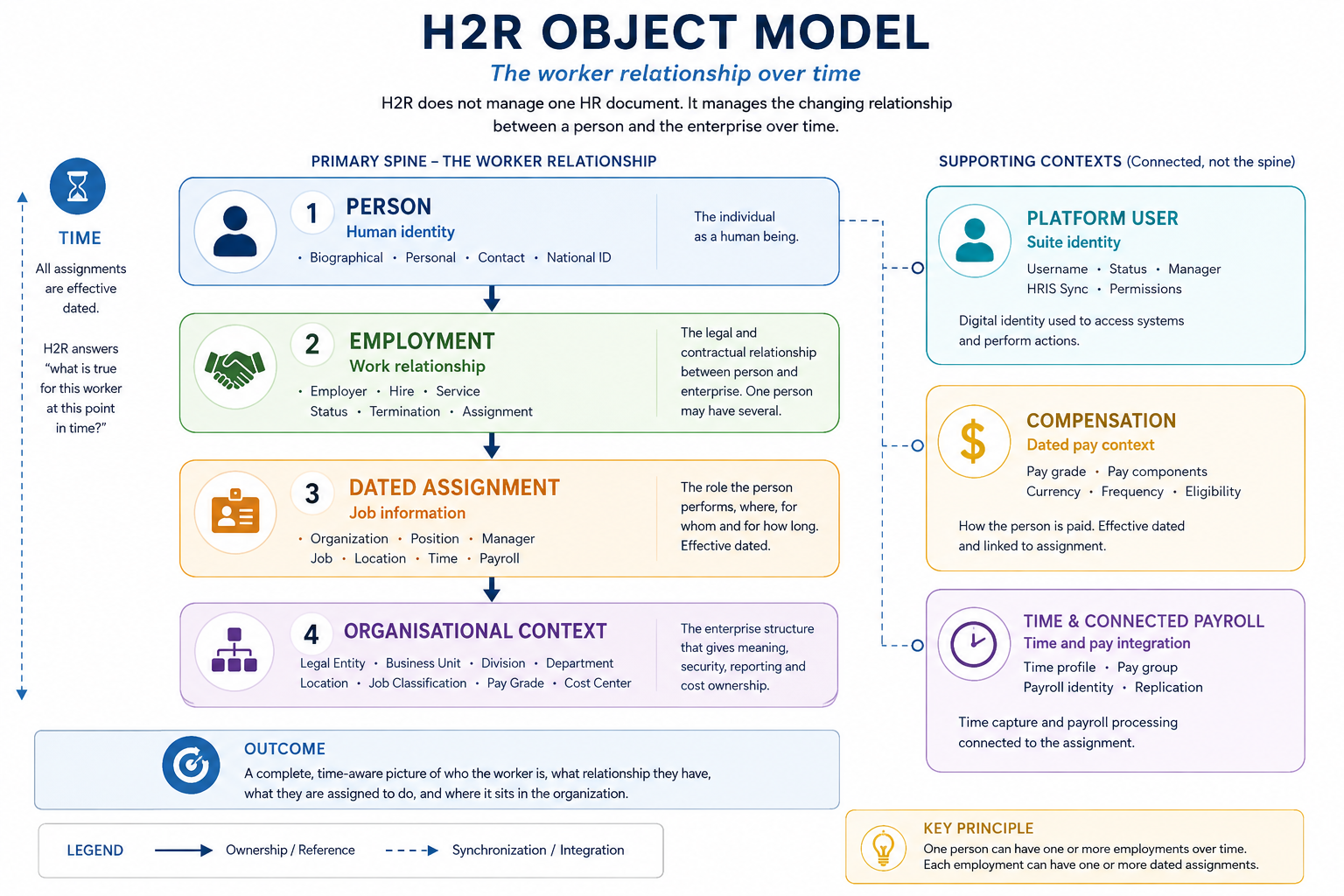
Employee Central does not treat a worker as one flat record. Person identity, one or more employment relationships, effective-dated job and compensation histories, positions, organizational foundation objects, platform user identity, and connected payroll identifiers work together.
READ THE MODEL
Separate the human being from each relationship and dated assignment
Start with the person. Person data identifies the human being independently of any employer, job, or assignment. That stable identity can support rehire and concurrent employment without duplicating personal history every time the work relationship changes.
Employment Information then records a relationship with a particular employer: hire and service dates, employment status, and the employment-specific identifiers needed for that relationship. One person can have more than one employment when the business scenario requires it.
Job Information and Compensation Information are effective-dated assignment records. They show what was true for that employment on a specific date—manager, position, organization, location, job, pay, eligibility, and payroll context—so a future transfer or pay change adds a dated record instead of overwriting history.
Position and foundation objects supply the shared organizational meaning, while platform user identity and payroll integrations carry selected information to connected systems. The key is to follow the value back to the object, effective date, permission, and integration that actually own it.
OBJECT RESPONSIBILITY
One worker, four connected information layers
Each layer owns a distinct part of the employee record, with its own identity, dating behavior, permissions, and integration consequences.
Stable human identity
Person, biographical, personal, address, email, phone, national ID, and relationship data describe the individual independently of a particular job assignment.
Relationship with an employer
Employment Information records hire, service, termination, and work-relationship context. One person can have multiple employments or assignments.
Job and compensation history
Effective-dated Job Information and Compensation Information preserve organizational, managerial, pay, and eligibility changes over time.
Position and foundation objects
Job Information references Position and shared objects such as Legal Entity, Business Unit, Division, Department, Location, Job Classification, Pay Grade, and Cost Center.
LIFECYCLE FLOW
What happens in Employee Central
The record grows through governed events rather than by overwriting one employee row.
Create or match the person
Stable person identity and personal information are established with duplicate checks, privacy controls, and country-specific data where required.
Create the work relationship
The employment records employer relationship, hire and service dates, status, and related employment identifiers.
Add effective-dated job and pay data
Job Information connects the employment to organization, manager, job, position, location, time, and payroll context; Compensation Information carries recurring pay structure.
Serve suite and payroll consumers
HRIS Sync updates platform user data, while governed integrations map the employment to payroll or S/4HANA identities such as personnel numbers where applicable.
DESIGN & CONTROL
What shapes the result
A field can appear on the same profile while belonging to a different object, date model, permission domain, and system owner.
Identity and multiplicity
Person identifiers, user identifiers, employment identifiers, rehire matching, concurrent employment, and global-assignment rules determine whether records represent one person or several relationships.
Effective dating and events
Hire, transfer, promotion, pay change, leave, termination, event reasons, workflows, and correction rules determine what was true on a selected date.
Structure, security, and integration
Foundation-object associations, position management, role-based permissions, HRIS Sync, API keys, and payroll replication mappings govern downstream behavior.
DIAGNOSTIC EVIDENCE
Diagnose the owning object before changing the screen
Profile cards combine several entities. Locate the record, effective date, source event, permission, and integration key that actually own the value.
Person ID, personal and biographical history, address, contact details, national IDs, dependents, privacy and permission scope.
Employment ID, company, hire and termination data, Job Information history, manager, position, organization, compensation, event, and workflow.
Platform user status, username, HRIS Sync result, payroll or personnel-number mapping, replication status, API key, and error evidence.
PROJECT MOMENT
One person, two valid employments
An employee retains one person identity while holding concurrent employments in two legal entities. Each employment has its own effective-dated Job and Compensation Information and may map to a distinct payroll personnel number, while the profile and permissions present the appropriate relationship for the selected context.
- Person identity is not duplicated
- Each employment has its own history
- Foundation references are date-valid
- Suite and payroll identities reconcile
Trace how person, employment, payroll, Finance, identity, and lifecycle evidence move across the H2R landscape.