S2C 202 · OBJECT MODEL
How do Service and Sales Orders work together?
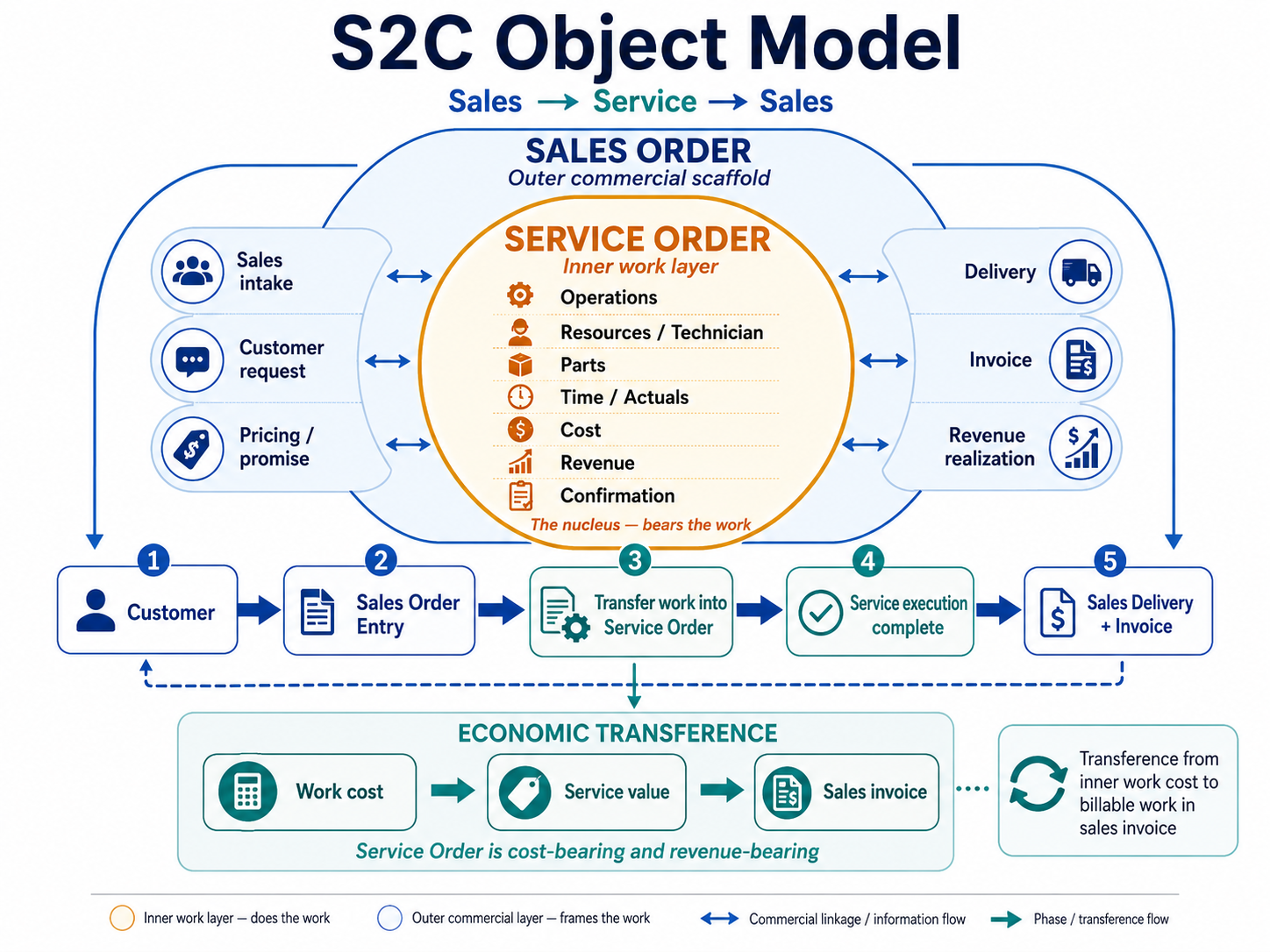
The Service Order is the nucleus of Service to Cash: it bears the work, its cost, and its confirmation. The Sales Order forms the commercial scaffold around it, carrying customer demand, delivery, invoicing, and revenue realization.
READ THE MODEL
The Service Order carries the work; the Sales Order carries the commerce
At its inner layer, the Service Order behaves much like a production or work order. It carries the operations to be performed, the technician or resources required, the parts consumed, the time spent, the actual costs incurred, and the confirmation that the service has been completed. Unlike a pure production order, however, it can also carry revenue. It sits at the point where operational work begins to acquire commercial value.
Around this nucleus sits the Sales Order as the commercial scaffold. It handles the parts of the process that extend beyond the work itself: customer demand intake, commercial terms and pricing before execution, and delivery and invoicing after the work is complete.
From an atomic view, the Service Order is the inner work-bearing object and the Sales Order is the outer commercial layer. The Service Order answers what work must be done and what did it cost? The Sales Order answers what did the customer buy, how is it delivered, and how will it be billed?
From a phase view, control moves Sales → Service → Sales. The customer first enters through sales. Once the commercial requirement is established, work transfers into the Service Order for planning, execution, and confirmation. After the service is complete, the process transfers back into sales for delivery, invoicing, and revenue realization.
OBJECT RESPONSIBILITY
One bridge connects work cost with service value
The Service Order is the bridge between operational and commercial worlds. Resources, parts, and time accumulate as work cost during service execution. Completed work is translated into service value that can flow into the sales invoice.
Sales intake
Capture the customer request, commercial terms, pricing, and promise before execution begins.
Service Order
Plan and perform operations with technicians, resources, parts, time, actuals, cost, and confirmation.
Service value
Translate completed, cost-bearing work into the billable value of the delivered service.
Sales delivery & invoice
Complete delivery, billing, and revenue realization through the sales process.
DIAGNOSTIC EVIDENCE
Trace each question to its owning layer
S2C becomes clearer when the team distinguishes the proof of work, the proof of value, and the proof of billing.
Operations, resources, parts, time, actuals, cost, and confirmations explain how the service was performed.
Customer request, pricing, terms, and delivery commitments explain what the customer bought.
Completed work, billable value, delivery, invoice, and revenue evidence explain how service execution became cash.
See how technicians, parts, time, confirmations, and acceptance create the completed service result.