PLANNING 202 · OBJECT MODEL
How is a production order put together?
See the connected structure SAP uses to plan, execute, confirm, cost, and settle one production run.
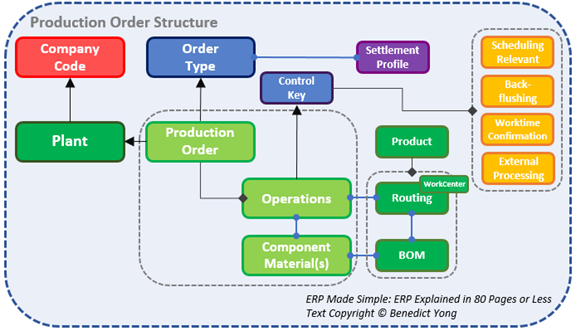
READ THE MODEL
The order turns a production proposal into controlled execution
Read from the organizational frame into the work itself. Company code, plant, and order type establish where production runs, who is responsible, and which processing rules apply. The production order then records the specific product, quantity, dates, status, cost collector, and settlement rule for one production run.
At creation, SAP selects the applicable production version, routing, and BOM from the product and plant context. Their data is copied into the order as the planned execution baseline, so the team can see which operations, work centres, standard values, and components were intended for this run—and can control approved changes afterwards.
Operations describe the sequence of work. Work centres provide capacity and costing context, while control keys determine scheduling, confirmation, costing, milestone, and external-processing behaviour. BOM components become reservations and material requirements with their own dates, storage, availability, issue, and backflush controls.
As work is released and confirmed, planned data is replaced by production evidence: goods issues, activity time, yield, scrap, rework, and finished-goods receipt. Period-end WIP, overhead, variance calculation, technical completion, and settlement then explain the order's operational and financial result.
OBJECT RESPONSIBILITY
Separate context, order control, execution, and material supply
These objects work together, but each owns a different decision and proof. Trace an issue back to the layer that determined it.
Company code, plant, and order type
The plant owns production execution, company-code assignment anchors accounting, and the order type establishes numbering and processing parameters.
Product, quantity, dates, and settlement
The header identifies what will be produced, how much, when, its current status, and how collected costs will be settled.
Routing, work centers, and control keys
Operations describe the work sequence. Work centers provide capacity and costing context, while control keys govern scheduling, confirmation, costing, and external processing.
BOM-derived material requirements
Components carry quantities, requirement dates, storage and issue information, reservations, availability status, and backflush behavior.
OPERATIONAL FLOW
What happens in SAP
The structure becomes executable as master data is selected, copied, checked, and then replaced by actual production evidence.
Establish the order frame
Product, plant, order type, quantity, dates, production version, and settlement rules establish the production and accounting context.
Select routing and BOM data
The order receives operations, work centers, component requirements, and standard values from the valid production master data.
Release, issue, and confirm
Availability and release permit execution. Confirmations record yield, scrap, time, and activities; component issues may be manual or backflushed.
Receive, calculate, and settle
Finished-goods receipt, overhead, WIP or variance calculation, technical completion, and settlement reconcile the order’s operational and financial result.
DESIGN & CONTROL
What shapes the result
Order behavior is distributed across header, operation, component, master-data, and period-end controls.
Order-level control
Order type, plant parameters, scheduling settings, status management, availability checks, costing variants, and settlement profile shape the order as a whole.
Operation-level control
Routing selection, work center, standard values, control key, confirmation parameters, milestone logic, and external-processing data determine how work is planned and recorded.
Component-level control
BOM selection, item category, requirement quantity and date, storage location, batch handling, issue method, and backflush indicator govern material staging and consumption.
DIAGNOSTIC EVIDENCE
Diagnose at the level where the result was determined
A scheduling, confirmation, component, or cost issue may appear on the same order but originate from a different control layer.
Plant, order type, product, quantity, basic and scheduled dates, production version, status, costing and settlement data.
Sequence, work center, control key, standard values, capacity requirements, confirmation status, external-processing data, and operation costs.
BOM source, reservations, requirement dates, availability, staging, goods issues, backflush results, goods receipt, actual cost, variance, and settlement status.
PROJECT MOMENT
One order, several control layers
A pump order selects a valid production version, copies assembly and test operations, explodes the component BOM, and reserves materials. Assembly is confirmed with backflush, testing records labor separately, finished goods are received, and remaining variance is settled.
- Order context is explainable
- Routing and BOM selection are traceable
- Confirmation and backflush agree
- Receipt, variance, and settlement reconcile
Connect this capability to the complete execution and integration story.