P2M 303 · PRACTITIONER PROCESS MAP
How does Plan to Make run in SAP?
A practitioner-provided view of production planning from sales orders and forecast demand through planned orders, make-or-buy decisions, dependent requirements, procurement, and production execution.
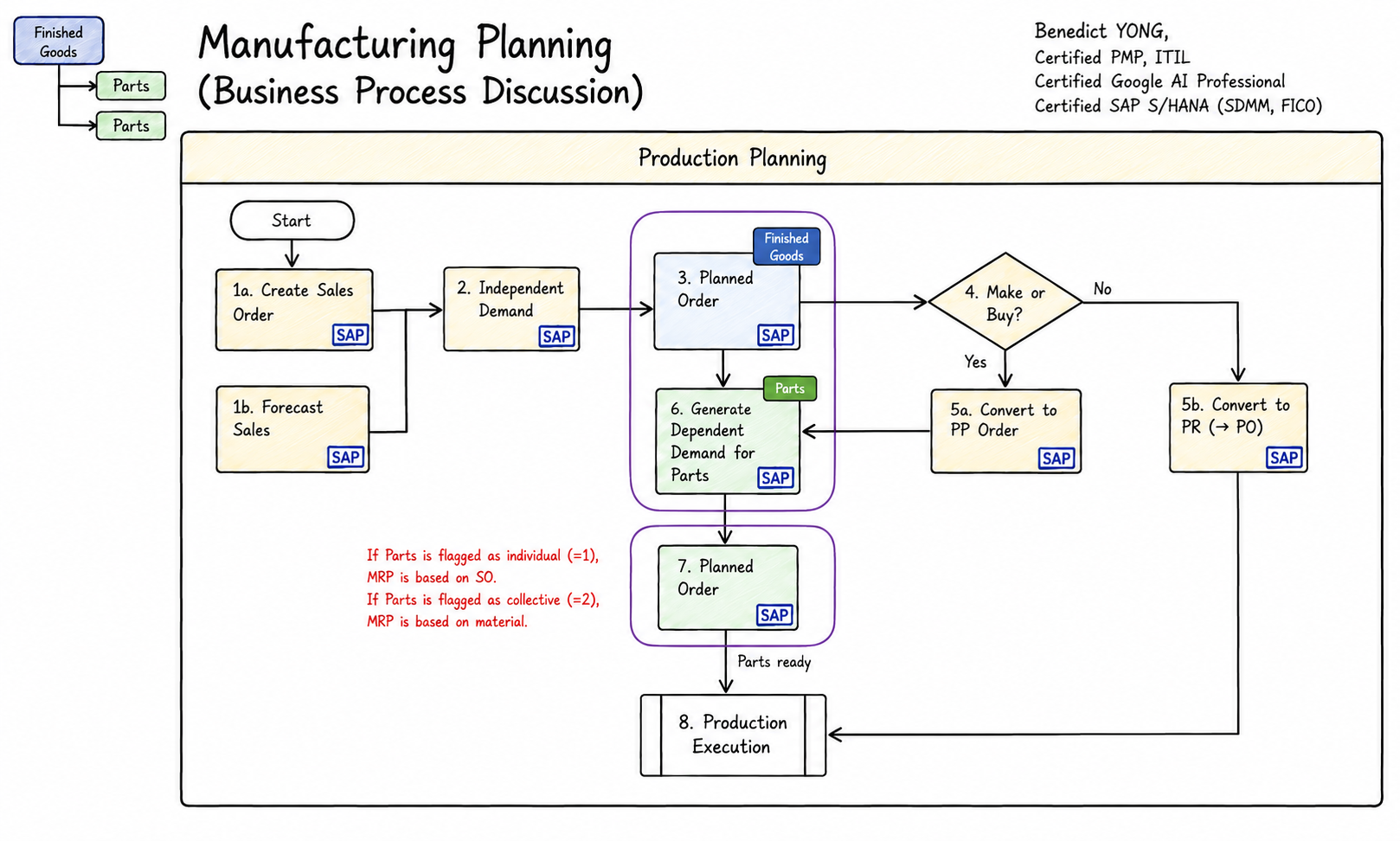
READ THE DIAGRAM
From demand signal to manufactured output
The diagram follows the planning decision in sequence. A sales order or forecast creates demand; MRP turns it into supply proposals; the make-or-buy choice determines whether supply is produced internally or purchased.
- 01
Create the demand signal
Establish the demand that planning must satisfy. A sales order represents actual customer demand (1a), while a forecast represents expected demand before orders exist (1b); validate material, quantity, date, planning strategy, and requirement type so demand enters the correct planning horizon and segment.
- 02
Maintain independent demand
Maintain independent requirements to consolidate the finished-goods demand that planning must cover. Check planning version, period, quantity, consumption behavior, and responsible owner; an incorrect forecast or requirement profile can create supply proposals that look technically valid but do not reflect the commercial plan.
- 03
Run MRP to create a planned order
Run MRP to compare demand with available stock, scheduled receipts, lead times, lot sizes, and planning settings. Review the dated finished-goods planned order and its exception messages, because it is a planning proposal; confirm its dates and quantities before converting it into an execution commitment.
- 04
Decide whether to make or buy
Use procurement type and related material master, sourcing, and planning data to determine internal production or external procurement. Validate the intended supply strategy, plant, special procurement, lead time, and source options; the decision changes the successor documents, owners, and exception path.
- 05
Convert the proposal into execution
Convert the approved supply proposal into the appropriate execution document. In-house supply converts the planned order to a production order (5a); external supply converts it to a purchase requisition and then a purchase order (5b). Check conversion status, quantities, dates, release, and linked-document continuity.
- 06
Explode dependent demand for components
Use the BOM to translate the finished-goods requirement into the components and quantities required for execution. Validate BOM alternative, validity date, quantity, unit of measure, and production version where applicable; component errors propagate into MRP proposals, availability, cost, and production execution.
- 07
Plan component supply
Run component planning so MRP creates dated planned orders or purchasing proposals for the required parts. Check stock, existing receipts, lead times, lot sizes, exception messages, and whether requirements are individual to a sales order or planned collectively at material level before releasing supply actions.
- 08
Execute production and receive finished goods
When required parts and capacity are available, release and confirm the production order, record component consumption, and post finished-goods receipt. Validate order status, confirmation, goods movements, quantities, variances, and stock result; this execution evidence closes the planning loop and makes supply available for fulfilment.
Connect the practitioner flow to the configuration decisions, dependencies, transport boundaries, and end-to-end proof required to make it work.