P2P 303 · PRACTITIONER PROCESS MAP
How does P2P run in SAP?
A practitioner-provided view of the Procure-to-Pay process across requisitioning, purchasing, goods receipt, invoice receipt, account assignment, and accounts payable.
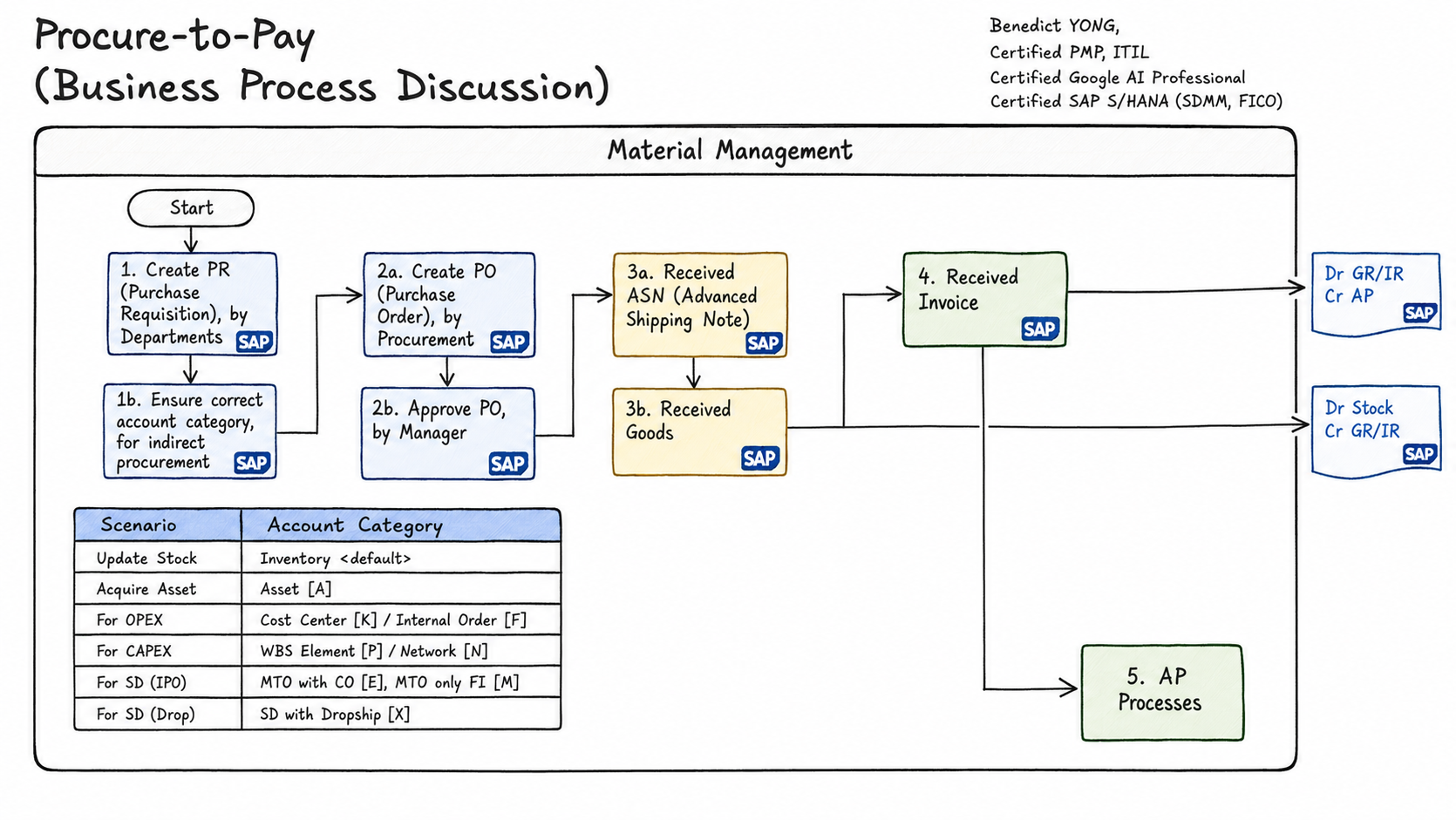
READ THE DIAGRAM
From approved need to cleared supplier payment
Read the diagram as a chain of business evidence: a need becomes an authorized request, then a supplier commitment, receipt proof, a verified liability, and a controlled payment.
- 01
Create the purchase requisition
Capture the approved need before a supplier is committed: material or service, quantity, delivery date, plant or receiving location, requester, and business purpose. Check completeness, source options, budget, and release status, because the requisition is the controlled demand signal for Procurement.
- 1b
Set the correct account category
For indirect procurement, set the account-assignment category and destination of the cost before creating the PO. Confirm the cost centre, internal order, WBS element, asset, or other object and its approval; a wrong assignment can make a valid purchase post to the wrong business owner.
- 02
Create and approve the purchase order
Create the supplier commitment with the approved supplier, items, quantities, prices, tax, delivery terms, account assignment, and receiving instructions. The PO must reach the required release status and output successfully; check contract or source reference, tolerances, and change history before it is sent.
- 03
Receive the shipping notice and goods
Use the supplier notice and physical receipt to establish what actually arrived. Post and review goods receipt, partial receipt, over- or under-delivery, quality or stock status, return, and delivery-complete indicators; this receipt evidence updates quantity and often records inventory or GR/IR value.
- 04
Receive and verify the supplier invoice
Compare the supplier claim with the PO and the applicable goods-receipt or service-acceptance evidence. Validate quantity, price, tax, prior invoices, and tolerance results; post the liability when the match is acceptable, or retain the explicit block and exception owner when it is not.
- 05
Process Accounts Payable and clear the liability
Manage the supplier invoice as an open item through due-date selection, payment proposal, approval, bank execution, and clearing. Check payment blocks, method, bank details, discount, remittance, bank response, and clearing document so payment is authorized and the liability is explainably settled.
READ THE PROCESS
What the diagram is really saying
The process is one governance chain with distinct evidence for demand, commitment, received value, liability, and settlement.
Turn a need into an approved request
The requisition defines what is needed and who bears the cost. Source rules, contracts, budget controls, and workflow determine whether Purchasing may proceed.
Make the commercial promise explicit
The purchase order records supplier, quantity, price, tax, dates, plant, account assignment, tolerances, approval, and output as one controlled commitment.
Use the evidence appropriate to the purchase
Materials use goods movements and stock or consumption evidence. Services use entry and acceptance. Partial receipts, returns, and reversals remain visible.
Match, record, pay, and clear
Invoice verification compares the supplier claim with the PO and receipt evidence. Accounts Payable and Treasury then control the open item, payment channel, and clearing proof.
INSIDE THE PURCHASE ORDER
Four foundations explain the downstream result
When the process diagram looks correct but the transaction behaves unexpectedly, inspect the operating context, supplier role, document structure, and determination mechanisms before changing configuration.
Material, organization, and stock
Confirm the master, planning, inventory, valuation, and organizational inputs that frame the purchase.
Open MM foundationsSUPPLIERIdentity, extensions, and partner roles
Separate central Business Partner identity from company-code, purchasing, payment, and transaction-role data.
Open supplier modelOBJECT MODELHeader, item, assignment, schedule
Locate data, indicators, and status at the level where SAP determined the result.
Open PO anatomyDETERMINATIONConditions, confirmations, workflow, output
Trace commercial value, expected supplier evidence, authority, and controlled external communication.
Open purchasing mechanicsTHE CRITICAL BRANCH
Receipt evidence changes with the purchase
P2P retains one governance chain, but the evidence of receipt differs. Materials use goods movements; services use service entry and acceptance. Invoice verification must match the appropriate evidence.
ACCOUNTING HAND-OFFS
Received value, liability, and cash are different events
Do not collapse goods receipt, invoice posting, and payment into one accounting moment. Each event has distinct evidence, ownership, timing, and reversal behavior.
Received value is recorded before the supplier invoice arrives.
Invoice verification creates the supplier liability and resolves received value.
The payment clears the supplier open item through the approved bank channel.
PRACTITIONER VIEW
What to watch across the chain
A real-world review reconciles authority, quantities, values, statuses, accounting, and exception ownership—not only the happy path.
Need and authority
Requester, material or service, quantity, delivery date, account assignment, budget, approval, and segregation of duties.
Source and commitment
Supplier, contract reference, price, tax, incoterms, tolerances, output status, and purchase-order approval.
Received evidence
Delivered quantity, quality or stock status, movement type, service acceptance, partial receipt, and delivery completion.
Match quality
PO quantity and price, receipt quantity, invoice amount, tax, duplicate checks, tolerance exceptions, and payment block.
Liability integrity
Supplier open item, reconciliation account, GR/IR balance, expense or asset assignment, due date, and payment terms.
Payment control
Proposal exceptions, bank selection, maker-checker approval, payment media, sanctions controls, and clearing status.
WHEN THE CHAIN BREAKS
Start with the last trustworthy business event
The missing successor is usually a symptom. Identify whether demand, commitment, receipt, liability, or settlement evidence first became incomplete.
Was demand approved and sourced?
Check requisition completeness, account assignment, release status, source validity, supplier block, agreement scope, and conversion status.
What does the match disagree with?
Compare ordered, received, accepted, returned, and invoiced quantities and values; then inspect price unit, tax, prior invoices, tolerance key, and block reason.
Was the liability eligible and authorized?
Check due date, payment block, method, bank data, proposal log, approval, payment-media status, bank response, and clearing document.
Connect the practitioner flow to the configuration decisions, dependencies, transport boundaries, and end-to-end proof required to make it work.