PROCURE TO PAY · OBJECT MODEL
How is a purchase order put together?
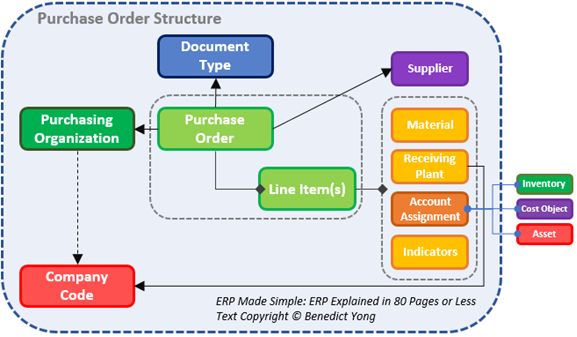
A purchase order is not one flat record. Organizational context, shared header data, item-specific behavior, account assignments, delivery schedules, and control indicators work together to make the supplier commitment executable.
READ THE MODEL
Structure separates shared commitment from item-specific execution
Start with the purchasing context. Company code, purchasing organization, purchasing group, plant responsibility, and document type establish who is buying, for which legal entity, and under which approval, numbering, field, and output rules. The purchase order then becomes the supplier-facing commitment created within that frame.
Header data holds terms that are normally shared across the commitment: supplier, currency, payment terms, incoterms, document date, approval state, and communication context. Item data states what is being bought and can vary by line: material or service, quantity, plant, price, tax, item category, and account-assignment category.
Execution detail explains how each item is fulfilled and accounted for. Schedules hold dates and quantities; account assignments identify the cost object, asset, or stock destination; goods-receipt, invoice, confirmation, tolerance, and completion indicators determine which successor documents are expected and allowed.
Read the PO together with its referenced evidence. Goods receipts, service entries, supplier invoices, accounting documents, changes, reversals, and completion status retain the PO and item reference, allowing the supplier commitment, receipt proof, liability, and final value to be traced without treating them as one event.
OBJECT RESPONSIBILITY
Keep purchasing context, commitment, item value, and execution evidence distinct
Each layer owns a different decision and proof. Put a value at the highest level where it remains true, then use item and execution detail for controlled differences.
Organization and document type
Company code, purchasing organization, purchasing group, plant responsibility, and PO type establish who buys, for whom, and under which processing rules.
Shared supplier commitment
Supplier, currency, payment terms, incoterms, document date, approval, and output context normally apply across the purchase order.
Material or service behavior
Material or service, quantity, plant, item category, price, tax, and account-assignment category can differ by line.
Schedules, assignments, and indicators
Delivery dates and quantities, cost-object distribution, goods-receipt and invoice indicators, tolerances, confirmations, and completion status govern what can follow.
OPERATIONAL FLOW
What happens in SAP
Read the sequence as one connected business event, not as isolated transactions.
Establish the purchasing context
Organization, document type, supplier, and reference documents establish the eligible master data, number range, field behavior, and approval context.
Build header and item commitment
Shared terms sit at header level while each item records its own object, quantity, price, plant, category, and accounting intent.
Determine follow-on behavior
Schedules, account assignment, goods-receipt and invoice indicators, tolerances, and confirmation control determine receipt, valuation, matching, and completion.
Create referenced evidence
Goods receipts, service entries, supplier invoices, accounting documents, changes, and reversals retain the PO and item reference.
DESIGN & CONTROL
What shapes the result
These controls work together; a locally correct setting can still produce the wrong end-to-end outcome.
Header-level control
Document type, supplier, purchasing organization, company code, currency, payment terms, approval, and output establish the shared commitment and communication.
Item and account-assignment control
Item category, material or service, plant, quantity, price, tax, account-assignment category, G/L account, and cost object define what is purchased and where value belongs.
Schedule and indicator control
Delivery schedules, confirmations, GR required, GR-based invoice verification, non-valuated receipt, delivery-complete, final-invoice, and tolerances shape successor documents and status.
DIAGNOSTIC EVIDENCE
Diagnose at the level where the result was determined
A header, item, account-assignment, or schedule issue can produce the same blocked outcome, but the cause and owner are different.
PO type, supplier, organization, company code, currency, terms, overall approval, output, change version, and header status.
Material or service, plant, item category, quantity, conditions, tax, account-assignment category, G/L account, cost object, and distribution.
Delivery schedule, confirmation, receipt and invoice indicators, tolerances, purchasing history, open quantity and value, and completion status.
PROJECT MOMENT
One supplier, two items, different accounting
A supplier receives one PO containing ten stock-managed motors and one calibration service. The header shares supplier and commercial terms, while the motor item receives into inventory and the service item carries a cost-center assignment and requires accepted service evidence before invoicing.
- Shared terms belong at header
- Each item behavior is explainable
- Accounting destination is explicit
- Follow-on indicators match the evidence
See how demand, sourcing, commitment, receipt alternatives, invoice matching, accounting entries, payment, and clearing connect.