MTO 202 · OBJECT MODEL
How does transfer of requirements create customer-specific supply?
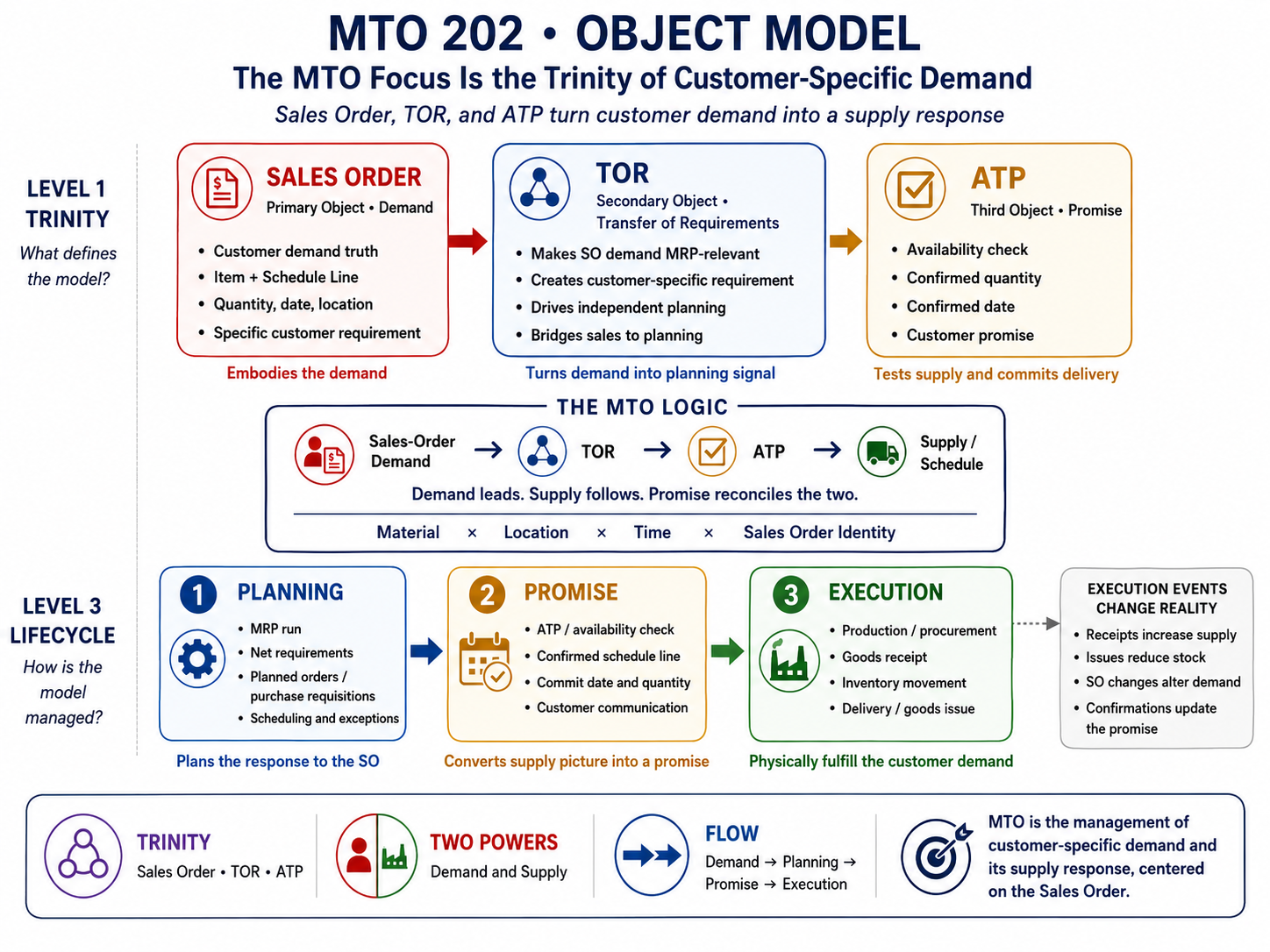
In Make to Order, the sales-order item is not merely a commercial request. Transfer of requirements turns its schedule-line demand into an individual planning requirement that MRP can cover with customer-specific supply.
READ THE MODEL
Transfer of requirements is the planning bridge from sales order to supply
The sales-order item and schedule line carry the customer material, configuration, quantity, and requested date. Requirements determination combines the item category, schedule-line category, material strategy group, requirements type, and requirements class to decide whether that demand becomes an individual planning requirement. Transfer of requirements does not create supply by itself: it creates the planning signal that MRP can evaluate.
MRP then plans inside the individual segment and can create a planned order, production order, purchase requisition, or other customer-referenced proposal. That reference is what keeps the resulting supply tied to the original sales-order item rather than silently joining general stock.
ATP is separate. It checks the eligible stock and receipts against requirements and writes the confirmed quantity and date to the schedule line. TOR can create planning demand even when ATP cannot yet confirm a date; ATP can also confirm from existing supply without changing the planning logic. The two controls meet on the same schedule line, but one answers “what supply must be planned?” and the other answers “what can be promised now?”
OBJECT RESPONSIBILITY
Keep the customer commitment, planning demand, supply, and value distinct
Trace the customer reference from commercial control through planning, execution, stock, and financial close. Each layer owns a different decision and proof.
Item and schedule line
Material, configuration, quantity, requested date, item category, and schedule-line category establish commercial and logistical behavior.
Type, class, and TOR
Strategy and requirements determination select a requirements type/class whose controls govern transfer, account assignment, availability, and costing behavior.
Pegged demand and supply
The sales-order item becomes an individual requirement. MRP creates planned orders or procurement proposals retaining the customer reference.
Order-specific output
Execution produces or procures the required output; where the strategy uses sales-order stock, receipt remains assigned until delivery, billing, and margin completion.
SYSTEM BEHAVIOR
How TOR carries customer demand into execution
The customer reference should remain explainable across every generated object.
Create the sales requirement
The item and schedule line record configuration, quantity, requested date, and control categories.
Create individual demand
Requirements determination and TOR expose customer-specific demand to MRP in the individual planning segment.
Create assigned supply
MRP explodes the relevant BOM and creates planned, production, purchase, or subcontracting supply tied to the sales-order item.
Deliver and settle
Order-specific output supports delivery and billing; logistics, actual cost, revenue, and margin retain traceability to the requirement.
DIAGNOSTIC EVIDENCE
Diagnose the control that owns the result
If MRP creates no customer-specific supply, verify schedule-line transfer, requirements determination, individual/collective indicator, planning file and MRP result before changing production. If supply exists but the date is not confirmed, diagnose ATP separately.
Sales document/item, schedule line, item and schedule-line categories, strategy group, requirements type/class, transfer flag, requested and confirmed dates.
Individual customer requirement, planning segment, pegging, MRP result, planned order, production order or purchase proposal, and customer reference.
Sales-order stock where used, goods movements, delivery, billing, cost object, variance, settlement, revenue, and margin evidence.
PROJECT MOMENT
One schedule line creates one traceable supply chain
A configured motor sales-order item transfers an individual requirement. MRP creates a pegged planned order and a purchase requisition for a special component. Production receives the motor into sales-order stock, then delivery and billing complete the same customer requirement.
- TOR creates individual demand
- MRP supply retains the customer reference
- ATP confirmation is diagnosed separately
- Delivery, cost, and revenue remain traceable
Connect this object model to execution, accounting impact, and exception handling.