MTO 303 · PRACTITIONER PROCESS MAP
How does Make to Order execute in SAP?
A practitioner-provided view of Make-to-Order execution from quotation and sales order through credit control, customer-specific manufacturing, delivery, goods issue, billing, accounts receivable, and accounting postings.
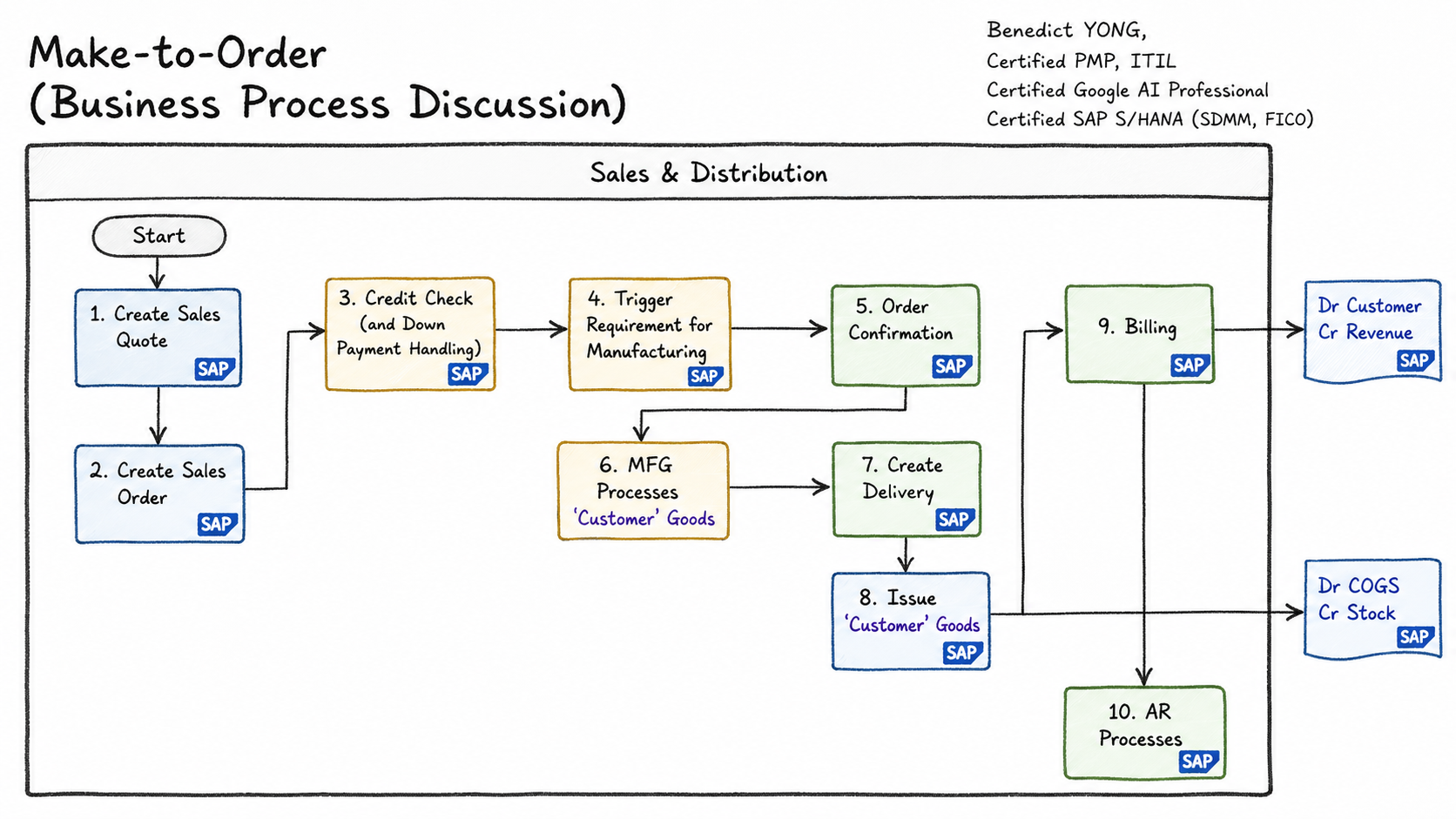
READ THE DIAGRAM
Follow the execution sequence
Use these steps to read the process from its demand signal through supply, execution, and the resulting inventory or commercial outcome.
- 01
Create the sales quotation
Where pre-sales evidence is needed, record the proposed product or configuration, quantity, date, price, validity, and commercial terms. Confirm that the quotation is traceable to the customer request; it is an offer, not yet the customer-specific supply requirement.
- 02
Create the sales order
Create the binding customer commitment with the correct sold-to and ship-to parties, item, quantity, requested date, pricing, tax, payment terms, and schedule-line behavior. Check that the sales-order item carries the intended requirement-transfer and account-assignment context before supply planning begins.
- 03
Perform credit and down-payment handling
Before the order advances, validate credit status, exposure, payment terms, down-payment requirement, incompletion, and any release block. Resolve the stated reason and retain approval evidence; an order may be saved but cannot become executable customer-specific supply until the required controls pass.
- 04
Trigger the manufacturing requirement
Use the approved sales-order item to create the manufacturing requirement that MRP and production must satisfy. Verify product or configuration, quantity, date, plant, requirement type, individual assignment, and planning status; the successor supply proposal must preserve the customer reference.
- 05
Confirm the order
Confirm the quantity and date that the customer-specific supply path can support. Compare requested and confirmed schedule lines, availability, production dependencies, and exceptions; communicate the feasible promise only when the underlying supply evidence supports it.
- 06
Manufacture the customer goods
Execute the customer-specific manufacturing process through the linked order, BOM, routing, components, operations, confirmations, quality checks, and receipt. Check status, quantity, scrap, rework, cost, and assignment continuity so output does not lose its relationship to the originating sales-order item.
- 07
Create the delivery
Create the delivery when the confirmed customer-specific output is due and eligible for shipping. Validate delivery relevance, assigned stock, quantity, shipping point, blocks, predecessor status, and pick or pack evidence; the delivery converts assigned supply into a controlled fulfilment hand-off.
- 08
Issue the customer goods
Post goods issue when the shipment evidence is complete. Confirm the assigned quantity, movement, stock reduction, delivery status, valuation, and reversal behavior; this proves fulfilment, updates document flow, and normally records cost of goods sold against the delivered customer-specific output.
- 09
Create billing
Create the billing document from completed commercial and delivery evidence. Validate billed quantity, price, tax, payer, output, and posting status; billing creates the customer receivable and revenue, so pricing or billing blocks must be resolved with explicit ownership.
- 10
Manage Accounts Receivable
Manage the invoice as an open item until payment is identified and cleared. Monitor due date, payment reference, deductions, disputes, partial or residual items, and collection status; the commercial chain is complete only when the receivable outcome remains explainable and linked to the originating order.
READ THE PROCESS
Follow the ten customer-specific execution steps
MTO succeeds only when the requirement reference survives from the accepted customer promise through planning, manufacturing, delivery, billing, and financial closure. Follow the diagram’s ten numbered steps and trace the sales-order item whenever quantity, cost, stock, or status differs.
Create the sales quotation
Where pre-sales evidence is needed, record the proposed product or configuration, quantity, date, price, validity, and commercial terms. Confirm that the quotation is traceable to the customer request; it is an offer, not yet the customer-specific supply requirement.
Create the sales order
Create the binding customer commitment with the correct sold-to and ship-to parties, item, quantity, requested date, pricing, tax, payment terms, and schedule-line behavior. Check that the sales-order item carries the intended requirement-transfer and account-assignment context before supply planning begins.
Perform credit and down-payment handling
Before the order advances, validate credit status, exposure, payment terms, down-payment requirement, incompletion, and any release block. Resolve the stated reason and retain approval evidence; an order may be saved but cannot become executable customer-specific supply until the required controls pass.
Trigger the manufacturing requirement
Use the approved sales-order item to create the manufacturing requirement that MRP and production must satisfy. Verify product or configuration, quantity, date, plant, requirement type, individual assignment, and planning status; the successor supply proposal must preserve the customer reference.
Confirm the order
Confirm the quantity and date that the customer-specific supply path can support. Compare requested and confirmed schedule lines, availability, production dependencies, and exceptions; communicate the feasible promise only when the underlying supply evidence supports it.
Manufacture the customer goods
Execute the customer-specific manufacturing process through the linked order, BOM, routing, components, operations, confirmations, quality checks, and receipt. Check status, quantity, scrap, rework, cost, and assignment continuity so output does not lose its relationship to the originating sales-order item.
Create the delivery
Create the delivery when the confirmed customer-specific output is due and eligible for shipping. Validate delivery relevance, assigned stock, quantity, shipping point, blocks, predecessor status, and pick or pack evidence; the delivery converts assigned supply into a controlled fulfilment hand-off.
Issue the customer goods
Post goods issue when the shipment evidence is complete. Confirm the assigned quantity, movement, stock reduction, delivery status, valuation, and reversal behavior; this proves fulfilment, updates document flow, and normally records cost of goods sold against the delivered customer-specific output.
Create billing
Create the billing document from completed commercial and delivery evidence. Validate billed quantity, price, tax, payer, output, and posting status; billing creates the customer receivable and revenue, so pricing or billing blocks must be resolved with explicit ownership.
Manage Accounts Receivable
Manage the invoice as an open item until payment is identified and cleared. Monitor due date, payment reference, deductions, disputes, partial or residual items, and collection status; the commercial chain is complete only when the receivable outcome remains explainable and linked to the originating order.
COMMON PP SPINE
Four foundations must retain the customer reference
When the chain breaks, follow the sales-order item and requirement rather than treating Sales, Planning, Production, Logistics, and Finance as separate investigations.
Sales-order requirement
Confirm product, configuration, item, schedule line, requirements type and class, account assignment, and transfer status.
Explore the requirementPROMISEAvailability and scheduling
Trace requested, material-availability, production, loading, goods-issue, and delivery dates with their confirmation evidence.
Explore the promiseSUPPLYPegged planning
Follow BOM demand, planned orders, purchase requisitions, exceptions, conversions, and customer-specific or collective assignment.
Explore MTO planningECONOMICSDelivery and margin closure
Reconcile assigned output, goods issue, billing, revenue, production cost, variance, settlement, and profitability.
Explore delivery and settlementTHE STRATEGY BRANCH
Order-specific demand does not force one stock or cost model
The approved design decides how tightly components, output, value, and profitability remain assigned to the originating sales-order item.
QUANTITY AND VALUE HAND-OFFS
Production completion, delivery, billing, and profitability are different gates
A delivered order can still have incomplete billing or cost closure. Reconcile the customer requirement across logistics and Finance rather than relying on one completion status.
Confirm component ownership, issues, confirmations, scrap, receipts, stock assignment, valuation, reversals, and production-order status.
Confirm delivery quantity, batch or serial data, stock segment, movement, material document, accounting document, and reversal status.
Confirm billing relevance, quantity, price, tax, account determination, billing block, invoice, accounting document, and sales-order reference.
Confirm cutoff, results analysis where applicable, production variance, settlement rules, profitability characteristics, ledger postings, and residual balances.
PRACTITIONER VIEW
What to watch across the customer-specific chain
The practitioner protects promise credibility, requirement ownership, change control, and explainable economics.
Requirement integrity
Configuration, quantity, requested date, rejection, cancellation, credit, incompletion, and change history can alter supply after it has been created.
Pegging and exceptions
Component shortages, external procurement, collective assemblies, rescheduling, firmed proposals, substitutions, and capacity constraints change the confirmed date.
Assigned execution
Release, component ownership, partial yield, rework, scrap, inspection, sales-order stock, batch or serial identity, and reversals must retain the correct reference.
Commercial closure
Delivery, billing, production cost, variance, results analysis, settlement, margin, open quantities, and residual balances must tell one customer-order story.
WHEN THE CHAIN BREAKS
Start with the sales-order item and its requirement
The missing production, delivery, or billing successor is often caused by an earlier determination or ownership decision.
Was demand transferred correctly?
Check item and schedule-line categories, requirements type and class, strategy group, account assignment, configuration completeness, plant, transfer status, MRP relevance, planning run, and exception messages.
Is the stock assigned and available?
Check production receipt, stock segment, sales-order assignment, batch or serial status, quality stock, confirmation, delivery relevance, schedule line, due date, blocks, and picking location.
Which commercial or cost event is incomplete?
Compare production issues and confirmations, receipts, goods issue, billing, price, revenue account, target and actual cost, variance, results analysis, settlement rule, profitability assignment, and reversals.
Connect the practitioner flow to the configuration decisions, dependencies, transport boundaries, and end-to-end proof required to make it work.