SCENARIO 01 · STOCK TRANSFER
When the user states the intent—not the transaction
During a Joule for Work demonstration, the user asked: “Initiate a stock transfer for MAT11 to Plant H.” The system then analyzed inventory context, checked relevant conditions, prepared the transfer, and executed it through the ERP controls behind the scenes.
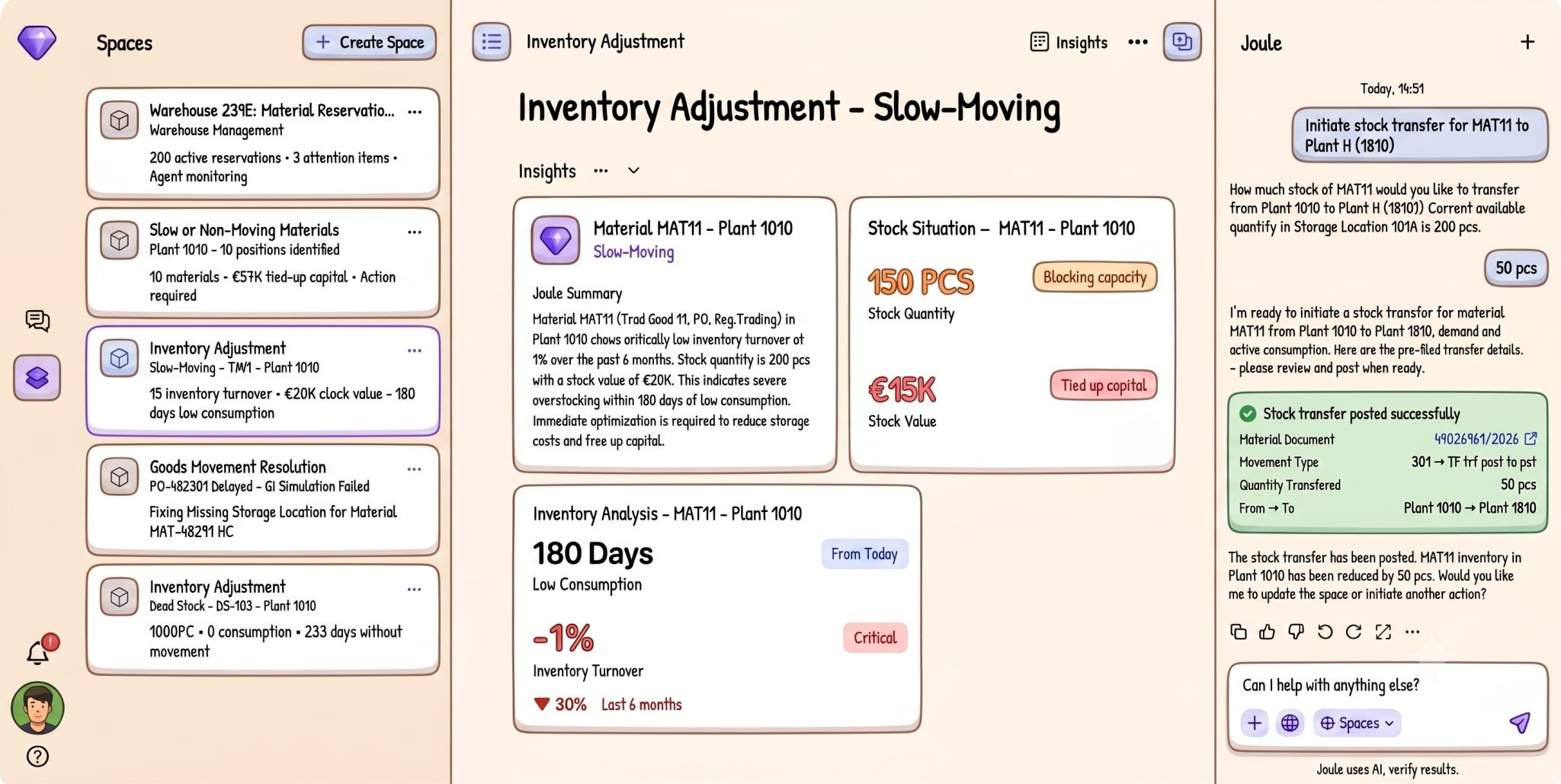
What changes for the business user
The user no longer needs to remember a transaction code, locate the right Fiori application, or translate a business need into a sequence of system fields. They can focus on the business decision while Joule handles the operational interaction.
What still happens underneath
- Identify the correct material, source, destination, and quantity.
- Analyze the current stock position and relevant inventory conditions.
- Apply movement type, stock status, plant, storage-location, and quantity rules.
- Respect authorization, availability, and process controls.
- Create a traceable ERP transaction and return a visible result to the user.
Where the value shifts
For business analysts and solution architects, the emphasis moves away from teaching navigation and toward designing dependable processes. The important questions become: Is the master data reliable? Are decision rules explicit? Which exceptions require a person? What is the agent permitted to prepare, approve, or execute?
The technology is impressive, but its production value depends on process quality, data quality, governance, authorization, and observable controls. Good architecture determines whether natural-language execution is safe and useful.
How this differs from Joule for Consultants
Joule for Consultants accelerates investigation and troubleshooting for specialists. Joule for Work changes the operating interface for business users: it turns expressed business intent into governed ERP work.