R2R FOUNDATIONS
What are the common objects in R2R?
R2R Object Environment
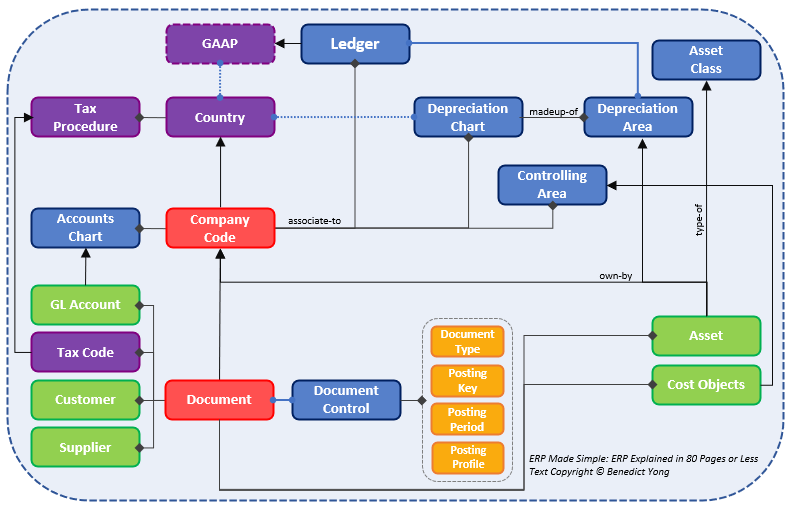
The Accounting Document — or Journal Entry — is the core transactional object of Record to Report. But a journal entry never exists in isolation. Every posting is created inside an accounting environment that determines which books it belongs to, which entity owns it, which accounts and business objects it refers to, and which rules govern how it is recorded.
The R2R Object Environment shows this surrounding structure.
At the top sit the accounting and organizational structures. Country and accounting principles influence the applicable ledger and valuation rules, while the Company Code identifies the legal accounting entity. The Chart of Accounts provides the common account structure, and the Controlling Area connects financial accounting with the management-accounting environment.
Around the Accounting Document are the business objects that give each posting its meaning. A line may point to a G/L Account, Customer, Supplier, Asset or Cost Object. These references explain not only what amount was posted, but also what the amount represents, who it relates to, and where responsibility or value belongs.
Other objects provide posting and valuation control. Document Type, Posting Key and Posting Period govern how and when transactions can be recorded. Asset Class, Depreciation Area and Depreciation Chart provide the additional structures required for asset valuation and depreciation. Tax Code and country-specific tax procedures apply the relevant statutory treatment.
The important point is that these objects do not compete with the Accounting Document as the R2R core object. They form its environment.
The Journal Entry records the event.
The Object Environment gives that entry its accounting context.
Once the environment is understood, the next step is to look inside the Journal Entry itself. The Universal Journal Anatomy then shows how this context is carried into individual accounting lines through their account, value, organizational, responsibility and source dimensions.
RECORD TO REPORT · STRUCTURE
How is the Universal Journal put together?
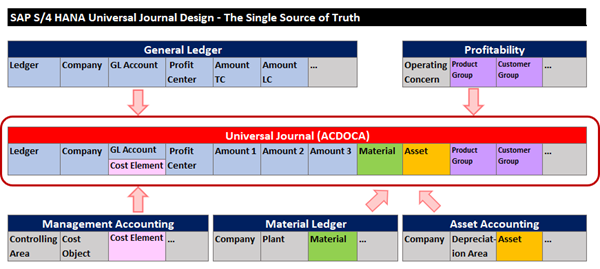
The Universal Journal stores accounting-relevant line items in ACDOCA with financial, management-accounting, material, asset, and profitability dimensions. The common line-item model lets one posting support several reporting views while retaining its source and accounting context.
READ THE MODEL
One line-item model connects financial and operational meaning
Start with the business event, not the table. A supplier invoice, goods movement, production confirmation, asset posting, payroll result, allocation, valuation, or manual journal supplies the source evidence. SAP then derives the accounting treatment and records balanced line items in the Universal Journal so the financial result remains connected to its operational origin.
Read a line from identity to meaning. Ledger, company code, fiscal year, document, and line item establish which books and legal entity were affected. The G/L account and debit or credit indicator classify the financial effect; amounts, currencies, quantities, and valuation context explain how much value was recorded and in which reporting perspective.
Then read the responsibility and operational dimensions. Profit center, cost center or order, material, plant, asset, customer or supplier, and profitability characteristics explain who is accountable, what business object was involved, and where the value belongs in management reporting. Not every line carries every field, but each populated field should be traceable to a source object or derivation rule.
The same line can therefore support statutory reporting, management accounting, asset and material views, and profitability analysis without creating separate unconnected records. When a result looks wrong, identify the missing or incorrect layer on the line first, then trace its source event, master data, account determination, substitution, or valuation rule.
OBJECT RESPONSIBILITY
Keep identity, classification, value, and dimensions distinct
One Universal Journal line carries these connected layers, but each owns a different question and proof about the accounting-relevant event.
Ledger, company, document, and line
Ledger, company code, fiscal year, accounting document, and line-item identifiers establish the book, legal entity, period, and document context.
G/L account and cost element
The account classifies the financial effect; integrated cost-element behavior connects relevant expense and revenue lines to management accounting.
Amounts and currencies
Transaction, company-code, group, and other configured currency amounts preserve the required valuation perspectives on the line.
Responsibility and operational detail
Profit center, cost object, material, asset, product group, customer group, and other characteristics explain ownership, source, and profitability.
OPERATIONAL FLOW
What happens in SAP
Read the sequence as one connected business event, not as isolated transactions.
Start with a business event
FI, CO, procurement, sales, production, inventory, asset, payroll, allocation, valuation, or interface activity creates accounting-relevant evidence.
Determine account and dimensions
Master data, account determination, organizational assignments, substitutions, and source objects populate the accounting context.
Write balanced journal line items
The posting records debits and credits with ledger, company, account, currencies, controlling, operational, and reference fields.
Report and trace to source
Financial statements, cost reporting, asset views, material valuation, and profitability analysis use the shared line-item evidence with drill-back to origin.
DESIGN & CONTROL
What shapes the result
These controls work together; a locally correct setting can still produce the wrong end-to-end outcome.
Document and ledger identity
Ledger, company code, fiscal year, document number, line item, document type, posting date, and source reference preserve book and document provenance.
Account and dimension integrity
G/L account master data, cost-object validity, profit-center derivation, asset and material assignments, and profitability characteristics must describe the same event.
Currency and integration integrity
Configured currency types, exchange rates, valuation logic, account determination, and reconciliation rules must produce consistent values across reporting views.
DIAGNOSTIC EVIDENCE
Read the line before changing the configuration
A report difference is diagnosed by locating the first missing or incorrect layer on the journal line and tracing it back to the source event and derivation rule.
Ledger, company code, fiscal year, document, line item, document type, posting date, source transaction, reference, user, and timestamp.
G/L account, debit or credit indicator, transaction amount, company-code currency, group currency, quantity, unit, and valuation context.
Profit center, cost center or order, material, plant, asset, customer or supplier, profitability characteristics, and originating document.
WORKED EXAMPLE
One production event, several reporting views
A component issue records inventory reduction and production-order cost with company, account, amount, material, plant, profit center, and order dimensions. Finance sees the journal impact, Operations traces the material movement, and Controlling follows cost on the same accounting evidence.
- Ledger and company are correct
- Account and currencies reconcile
- Operational source is traceable
- Responsibility dimensions are complete
See how continuous accounting, operational cut-off, parallel subledger workstreams, GL close, reporting, group handoff, and period control connect.