R2R 303 · PRACTITIONER PROCESS MAP
How does R2R close and report?
A practitioner close view across operational cut-off, parallel source workstreams, local accounting, entity reporting, group handoff, and period control.
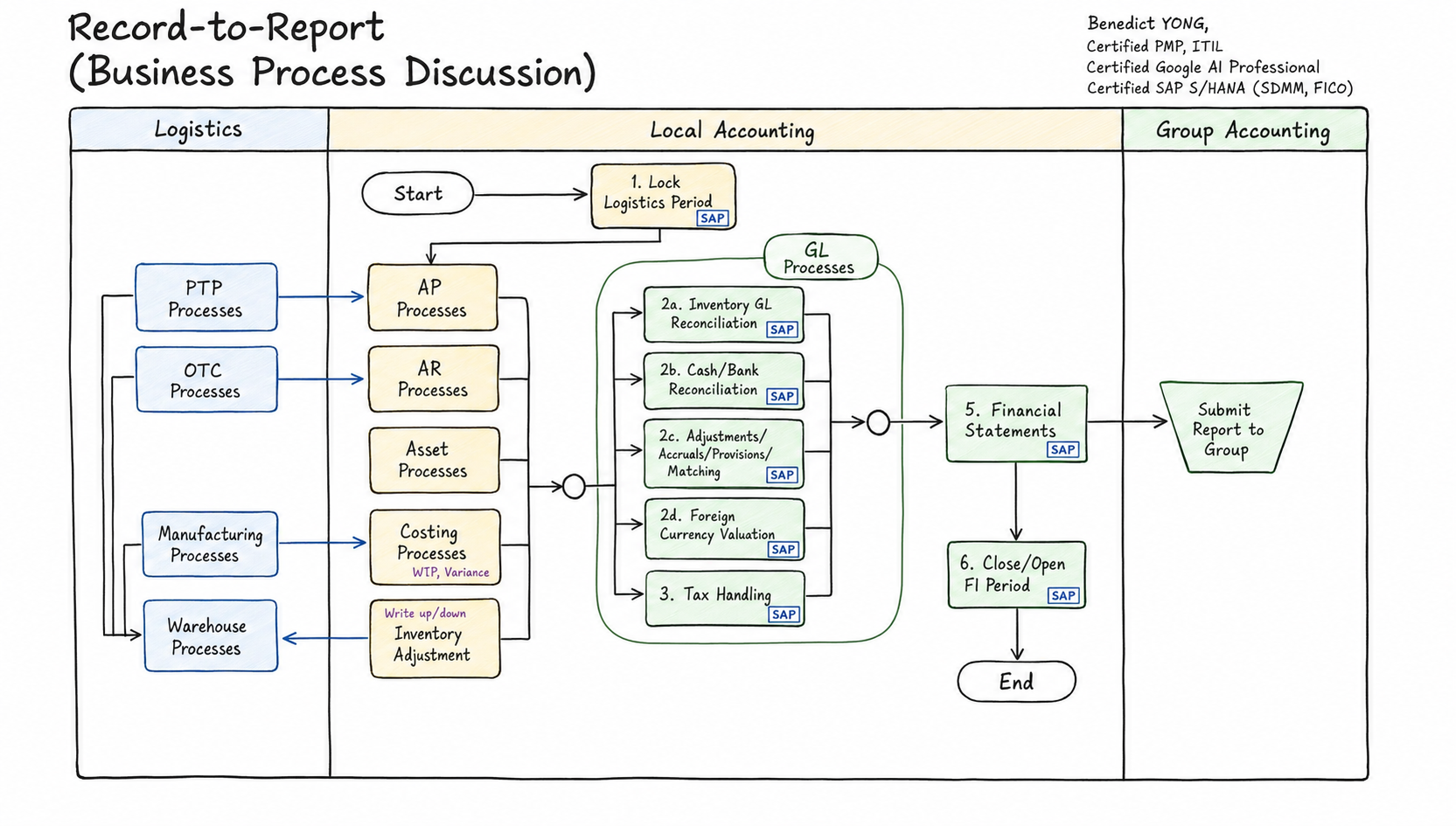
READ THE DIAGRAM
From operational cut-off to published reporting
Read R2R as a controlled close sequence: protect the reporting population, complete source work, reconcile and adjust, then release trusted statements and the next period. The diagram carries seven numbered stages organized into bands: 01-02 cut-off and parallel source work, 03-04 the general-ledger close, and 05-07 reporting and period control. The six reading steps below state one milestone each, splitting those bands, so prose and diagram agree.
- 01
Set cut-off and protect the reporting population
Set and communicate the operational and Finance cut-off so the period has a controlled population of business events. Check posting-period status, late-arrival rules, accrual ownership, and material exceptions; without a clear boundary, every later reconciliation can be correct only temporarily.
- 02
Complete subledger and operational work
AP, AR, inventory, assets, payroll, bank, tax, manufacturing, and intercompany teams complete their owned postings, interfaces, clearing, and exceptions. Track each workstream against a close calendar with a named owner, evidence of completion, and an escalation for items that could change the ledger.
- 03
Reconcile source evidence to the general ledger
Prove that operational detail, subledgers, bank records, and intercompany counterparties agree with the general ledger. Explain every variance by amount, age, cause, and owner; do not treat a matching total as complete when open reconciling items lack a resolution date or evidence trail.
- 04
Post period-end adjustments and valuation
Record accruals, depreciation, allocations, foreign-currency valuation, provisions, reclassifications, and tax adjustments in the correct period and accounting basis. Validate the calculation, approval, posting document, reversal or recurrence treatment, and supporting schedule before the ledger is presented for review.
- 05
Review, consolidate, and publish reporting
Review the controlled ledger result for completeness, reasonableness, disclosures, and unresolved exceptions before reporting. Entity teams validate statements and sign-off evidence; where applicable, group reporting then applies mapping, translation, eliminations, consolidation adjustments, and the required approval trail.
- 06
Close the period and open the next
Restrict unapproved changes to the closed period while retaining a governed path for corrections, audit requests, and late information. Preserve close certificates, reconciliations, journals, approvals, and issue logs; then confirm that the next period is open for normal operations with the right controls in place.
READ THE CLOSE
What the diagram is really saying
R2R is a dependency network. Source workstreams progress in parallel, the general ledger coordinates their evidence, and reporting advances only when required populations and exceptions are controlled.
Create a stable reporting population
Logistics and operational periods are controlled so late material, billing, invoice, asset, payroll, and manual activity cannot silently change the close population.
Finish source and subledger workstreams
AP, AR, assets, manufacturing, inventory, bank, tax, and intercompany teams complete postings, clearing, reconciliation, and owned exceptions on coordinated schedules.
Execute the general-ledger close
Finance reconciles balances and runs accruals, provisions, depreciation, allocation, foreign-currency valuation, reclassification, and tax activities under the applicable accounting principles.
Approve statements, submit, and lock
Entity statements are reviewed before group handoff. Reconciliation, mapping, translation, adjustment, and elimination remain distinct from local period access and close certification.
THREE ACCOUNTING RHYTHMS
The diagram shows month-end, but R2R starts earlier
Reliable close performance depends on continuous accounting and adds further obligations at year-end.
Record, clear, and resolve
Process source events and interfaces, clear open items, reconcile bank activity, and own posting failures.
Explore bank and cashMONTH-ENDCut off, measure, and certify
Complete subledgers, reconcile, value, adjust, review, report, submit, and restrict late posting.
Explore close governanceYEAR-ENDConfirm, disclose, and carry forward
Add balance confirmations, audit, statutory work, reclassification, carry-forward, and fiscal-year closure.
Explore reportingPARALLEL WORKSTREAMS
One close, different evidence
R2R is not a single serial transaction. Multiple source workstreams close in parallel, while the general ledger coordinates dependencies and only advances when required evidence and exceptions are controlled.
CLOSE OUTPUTS
Each gate produces different evidence
Cut-off, GL close, entity reporting, and group reporting are related but not interchangeable completion claims.
Late operational activity is prevented or explicitly governed so the close has a stable population.
Reconciliations and close entries place balances in the correct period and valuation basis.
Approved balances become statutory, management, and consolidation outputs with traceable support.
PRACTITIONER VIEW
What the close owner watches
The practitioner follows populations, dependencies, evidence, exceptions, approvals, and period access rather than a checklist alone.
Cut-off discipline
Material, billing, supplier invoice, asset, payroll, and manual-posting cut-offs; late-entry approval; and close-calendar status.
Subledger completeness
AP, AR, assets, inventory, manufacturing, bank, tax, and intercompany populations agree to their reconciliation accounts.
Reconciliation evidence
Prepared balance, source detail, unexplained difference, owner, ageing, reviewer, sign-off, and retained support.
Adjustment quality
Business rationale, calculation, accounting policy, dimensions, reversal logic, supporting evidence, preparer, and approver.
Valuation and tax
Exchange rates, valuation method, scope, posting logic, deferred or current tax inputs, and local compliance deadlines.
Reporting and lock
Trial-balance approval, statement review, group submission status, unresolved exceptions, posting-period authorization, and close sign-off.
WHEN THE CLOSE BREAKS
Start with the incomplete population or failed dependency
A late task is often a symptom. Identify which business evidence is missing before forcing completion or posting a compensating journal.
Is the comparison population complete?
Align company, ledger, currency, key date, account scope, posting status, reversal timing, source extraction, and reconciliation-account assignment.
Can the run be reproduced safely?
Inspect selection, run ID, method, rate or driver, prior update, log, posting period, account determination, reset or reversal behavior, and rerun ownership.
Are report views aligned?
Align company, ledger, currency, period, hierarchy validity, account assignment, unassigned accounts, adjustments, eliminations, and approval status.
Connect the practitioner flow to the configuration decisions, dependencies, transport boundaries, and end-to-end proof required to make it work.