R2R 707 · SPECIAL EDITION
SAP FI Certification View
Use this special edition to orient yourself to SAP Financial Accounting product knowledge: what the certification covers, how published exam areas are grouped, and how key FI concepts connect. It complements—rather than extends—the R2R 101–606 learning path.
CERTIFICATION CONTENT
Five FI curriculum clusters
SAP FI certification is strongly oriented toward product capabilities, configuration objects, and processing mechanisms. The amount of material assigned to a topic does not measure its business importance or operating effort.
| Cluster | Focus | Typical topics |
|---|---|---|
| ESSENTIAL FI | Shared Financial Accounting foundation | G/L, organizational structure, accounting documents, master data, tax, clearing, currencies, account determination, and integration. |
| AP | Accounts Payable and payment automation | Automatic Payment Program, payment methods and terms, house banks, bank determination, proposals, runs, payment media, and supplier clearing. |
| AR | Accounts Receivable and collection | Dunning procedures, levels, intervals, charges, correspondence, runs, notices, and customer receivables follow-up. |
| AA | Asset Accounting and depreciation | Asset masters, charts of depreciation, depreciation areas and keys, acquisitions, transfers, retirements, AuC, and depreciation. |
| CLOSING | Period-end and year-end close | Foreign-currency valuation, accruals, recurring entries, reconciliation, depreciation, period control, and financial statements. |
CERTIFICATION EXAM WEIGHTING
Published SAP exam-area ranges
APP and Dunning are normally included within the broader Accounts Payable & Accounts Receivable area; this page does not assign them invented official percentages.
| SAP exam area | Published weight | Related 707 cluster |
|---|---|---|
| Financial Closing | 11–20% | Closing |
| General Ledger Accounting | 11–20% | Essential FI |
| Accounts Payable & Accounts Receivable | 11–20% | AP / AR |
| Asset Accounting | 11–20% | AA |
| Organizational Assignments & Process Integration | 11–20% | Essential FI |
| SAP S/4HANA / platform-related topics | ≤10% where applicable | Common S/4 section |
| Managing Clean Core | ≤10% where applicable | Common S/4 section |
COMMON S/4 CERTIFICATION TOPICS
Shared product context
These are reusable S/4 certification themes, not a sixth FI cluster. They can be reused by future 707 Special Editions.
S/4HANA architecture
Know the deployment and application context in which FI capabilities run.
Simplified data model
Recognize the streamlined S/4HANA data model and Universal Journal implications where relevant.
Clean Core and extensibility
Understand principles for keeping the core upgradeable while using appropriate extension options.
Fiori and current cloud concepts
Recognize role-based UX, implementation, and cloud concepts that apply to the current certification scope.
FI CERTIFICATION MINDMAP
Use the diagram as a mnemonic
The visual helps connect the FI vocabulary before you revisit the detailed concepts below.
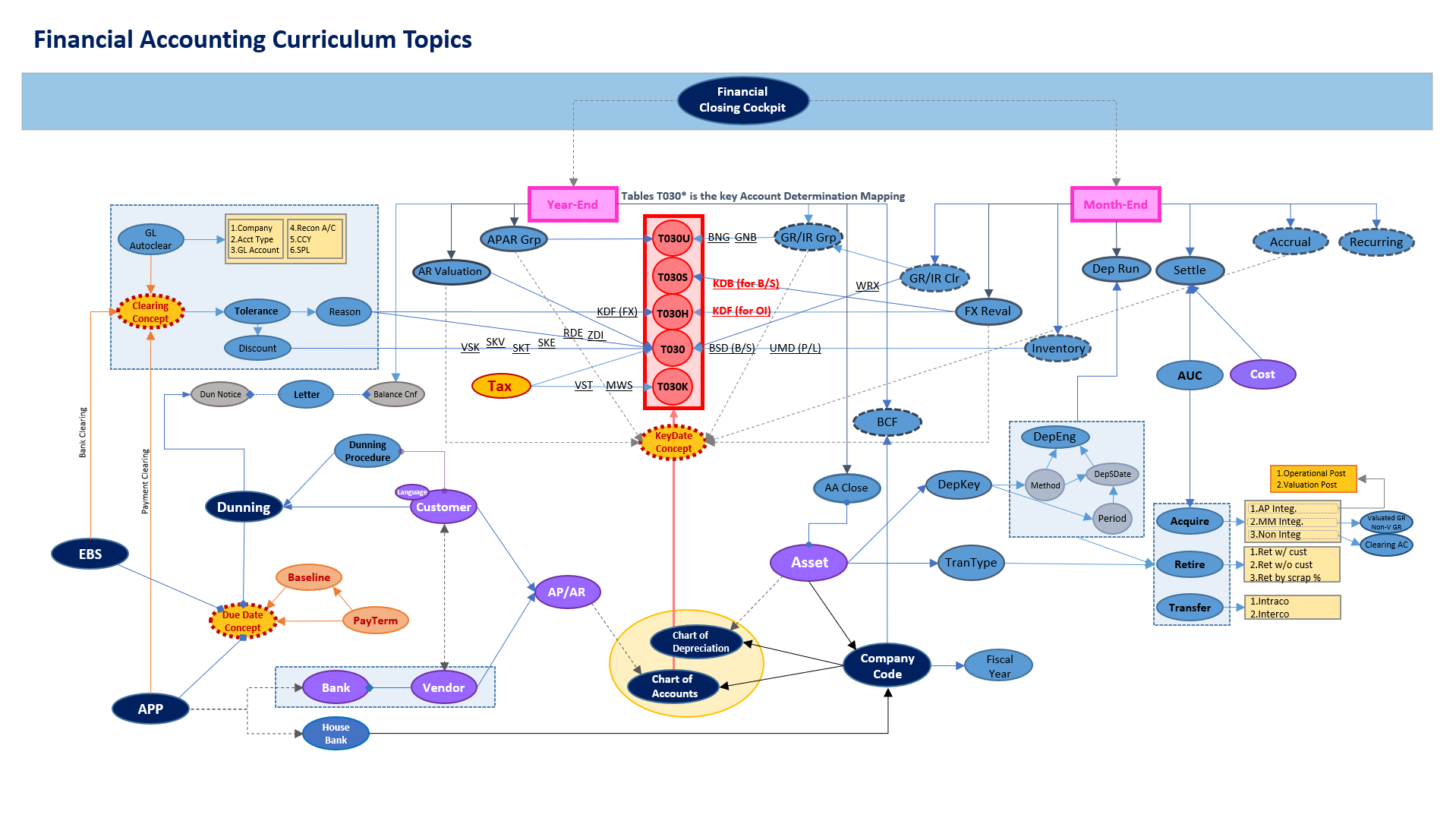
READ THE FI MINDMAP
One FI mind tree, not fragmented terms
Read the diagram from the shared accounting frame outward. Essential FI gives every branch its accounting context; AP, AR, and AA create their own evidence paths; Closing brings those paths back together into reporting.
Use this tree to remember what each diagram branch does and where it returns.
- ESSENTIAL FIThe accounting frame
Company Code · Fiscal Year · Chart of Accounts · G/L · document control · account determination
Sets the legal, calendar, account, and posting rules that every FI branch shares. - APPay suppliers
Vendor open items → due date → payment program → house bank → clearing
Turns supplier liabilities into a controlled, bank-reconcilable payment result. - ARCollect from customers
Customer open items → due date → dunning → correspondence → clearing
Turns unpaid customer items into an owned follow-up and collection path. - AAAccount for long-lived assets
Asset master → acquisition / transfer / retirement → depreciation → FI posting → close
Connects an asset’s lifecycle to its periodic accounting and reporting value. - CLOSINGConverge into reporting
Reconcile · value · adjust · depreciate · close · report
Brings the G/L, AP, AR, AA, inventory, and period-end controls into a defensible financial result.
KEEP THE VIEWS DISTINCT
Certification is the product landscape
Use 303 to understand how Finance performs and controls R2R, 404 to design and prove the solution, and 707 to orient your SAP FI certification preparation.