RECORD TO REPORT · ACCOUNT MAP
How does SAP determine FI-GL accounts?
Operational events do not post to FI-GL by accident. SAP combines transaction context, master data, valuation, mapping rules, and organizational assignments to determine the accounting result.
INTEGRATION / ACCOUNT DETERMINATION
One business event passes through governed mapping before it reaches FI-GL
Sales, purchasing, inventory, production, HR, assets, banking, and Controlling each bring their own source context. SAP does not select an account from the event name alone: it evaluates the relevant organizational assignment, master data, transaction or account key, valuation context, movement or billing behavior, and approved mapping rule. The resulting journal must explain both sides of the posting—what created the debit or credit, why that FI-GL account was selected, which business object owns the value, and how a reviewer can trace the line back to the source document, its rule inputs, and any subsequent reversal, clearing, or settlement.
READ THE MAP
From operational trigger to FI-GL
The determination route varies by process, but every posting needs a source event, rule inputs, a governed mapping, and retained journal evidence.
Post an operational event
Examples include billing, goods receipt, goods issue, payroll, asset activity, bank processing, and settlement.
Resolve the source context
Material valuation, movement type, transaction and account modifier, pricing, reconciliation account, symbolic account, or CO receiver provide the rule inputs.
Select FI-GL accounts
Determination logic maps the approved inputs to the required debit and credit accounts and accounting dimensions.
Trace the resulting journal
Use source references, document flow, account lines, and reversal or clearing evidence to reproduce the result.
HOW TO READ THE MAP
The red FI-GL box is the result—not the starting point
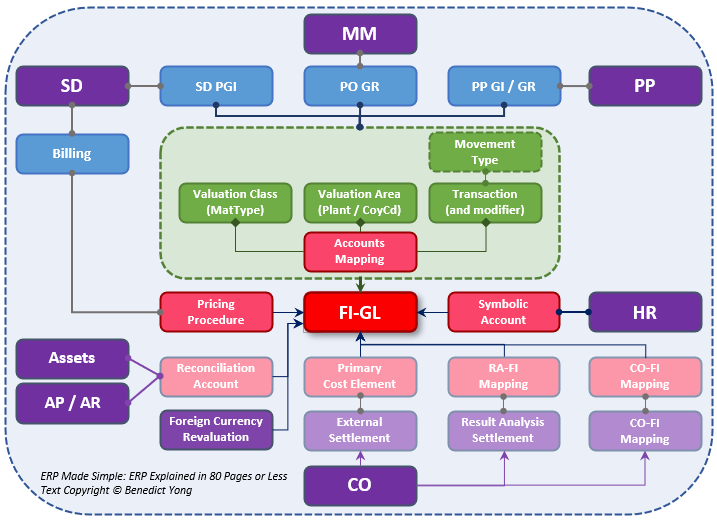
The map shows several determination routes converging on FI-GL. An SD billing event normally carries pricing and account-key context. MM and PP events use valuation, movement, transaction-key, and account-modifier context. HR uses symbolic accounts. Assets, AP/AR, and CO bring their own reconciliation, settlement, and cost-assignment logic. The accounting line is explainable only when the source event and the selected rule inputs are known together.
- Start with the business event
- Identify the exact rule inputs
- Find the selected mapping row
- Confirm the resulting FI-GL lines
Material and movement mapping
Valuation class, valuation area, movement type, transaction key, and account modifier are key inputs for inventory and production postings.
Subledger and symbolic accounts
Customer and supplier reconciliation accounts, payroll symbolic accounts, and asset mappings connect specialist records to the general ledger.
Commercial and CO mapping
Pricing, revenue and tax account keys, cost elements, settlement rules, and profitability assignments complete the financial result.
COMMON DETERMINATION PATHS
The same FI-GL outcome can have very different source logic
Do not troubleshoot an account by looking at the G/L master alone. First identify which application produced the line and which keys that application supplied.
MM and PP
A goods movement or production event supplies valuation area, valuation class, movement type, transaction key, and possibly an account modifier. These inputs determine inventory, consumption, GR/IR, price-difference, or production-offset accounts.
SD billing
A billing document supplies sales, item, pricing, and account-key context. The result must explain revenue, discounts, freight, tax, and customer receivable lines as well as any profitability characteristics.
AP, AR, assets, HR, and CO
Reconciliation accounts connect business partners to FI-GL; asset class and transaction type guide Asset Accounting; symbolic accounts guide payroll; and settlement or allocation rules direct Controlling value to its receiver.
WHEN AN ACCOUNT IS WRONG
Trace the rule path before changing the mapping
A posting can be balanced yet still be assigned to the wrong account. The fastest safe diagnosis follows the actual document context through the determination inputs to the selected mapping.
Record company code, ledger, document and item, posting date, source application, source document, material or business partner, movement or billing type, and the unexpected FI-GL account.
Identify the valuation, transaction, account key, modifier, reconciliation, symbolic-account, asset, pricing, or settlement inputs that were active for that source event.
Change only the approved mapping in a controlled environment, then post or simulate a representative case and reconcile source, journal, and reporting impact.