MTS 303 · PRACTITIONER PROCESS MAP
How does Make to Stock execute in SAP?
A practitioner-provided view of Make-to-Stock execution from production-order creation and release through material issue, inspection, confirmation, finished-goods receipt, accounting postings, and settlement.
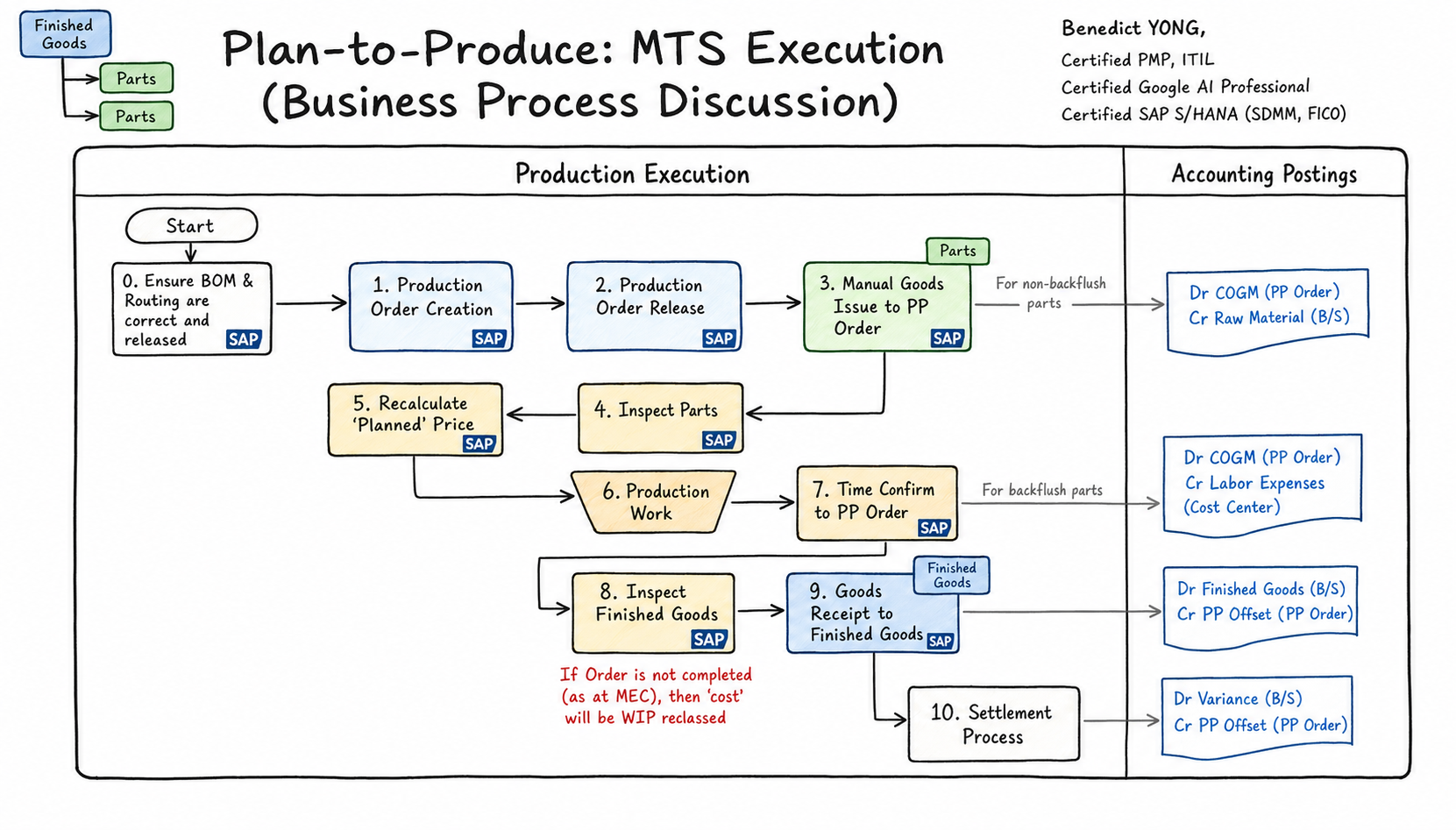
READ THE DIAGRAM
Follow the execution sequence
Use these steps to read the process from its demand signal through supply, execution, and the resulting inventory or commercial outcome.
- 01
Create the production order
Convert the approved planned supply into a production order with material, plant, quantity, dates, BOM, routing, operations, components, work centers, and cost controls. Check the selected production version and linked proposal; the order becomes the accountable execution and cost-collection object.
- 02
Release the production order
Release the order only when its technical and business prerequisites are met. Confirm status, component and capacity readiness, production version, dates, availability checks, and any required approvals; release authorizes shop-floor activity and makes missing readiness evidence an explicit exception.
- 03
Issue components to the order
For non-backflushed components, post the manual goods issue to record physical consumption against the production order. Validate material, batch or serial data, quantity, storage location, valuation, reservation, reversal status, and order assignment; this reduces raw-material inventory and records actual material cost.
- 04
Inspect parts
Inspect components when the process requires quality evidence before or during consumption. Record the inspection result, accepted or rejected quantity, stock status, defect, and disposition; do not allow an unresolved quality decision to be hidden by a technically posted goods issue or confirmation.
- 05
Recalculate planned price
Refresh the planned cost or price when the diagram’s process requires the order’s plan value to reflect approved material, activity, or cost assumptions. Check the costing basis, effective date, quantity structure, and approval; planned value is the benchmark used to explain later actual cost and variance.
- 06
Perform production work
Execute the routing operations using the approved work centers, people, machines, and methods. Monitor operation status, component availability, capacity, yield, scrap, rework, and deviations from the schedule; physical progress must remain traceable to the released production order.
- 07
Confirm time to the order
Record operation confirmation, yield, scrap, and labor or machine activity against the production order. Validate operation, activity quantity, rate basis, partial or final status, backflush behavior, and correction history; confirmation supplies both progress evidence and actual activity-cost posting.
- 08
Inspect finished goods
Inspect the completed output before making it available for normal use where the quality process requires it. Record the inspected quantity, result, defect or usage decision, stock type, and rework or rejection path; finished output is not equivalent to unrestricted stock until the quality decision is complete.
- 09
Receive finished goods
Post goods receipt from the production order to increase finished-goods stock and record the order’s delivery evidence. Check material, plant, storage location, stock type, quantity, valuation, inspection result, order status, and reversal behavior; this is the event that makes completed supply visible to fulfilment.
- 10
Complete settlement processing
At period end, calculate and settle the eligible production-order balance using the approved rule and receiver. Review WIP or variance where applicable, settlement profile, target and actual cost, account determination, run log, and residual balance; the order is not financially closed merely because goods receipt posted.
READ THE PROCESS
Follow the ten execution steps in the diagram
BOM and routing readiness is the unnumbered prerequisite. Once forecast-led planning has produced an executable proposal, follow the diagram’s ten numbered steps from production-order creation through settlement; each one adds quantity, status, quality, or cost evidence.
Create the production order
Convert the approved planned supply into a production order with material, plant, quantity, dates, BOM, routing, operations, components, work centers, and cost controls. Check the selected production version and linked proposal; the order becomes the accountable execution and cost-collection object.
Release the production order
Release the order only when its technical and business prerequisites are met. Confirm status, component and capacity readiness, production version, dates, availability checks, and any required approvals; release authorizes shop-floor activity and makes missing readiness evidence an explicit exception.
Issue components to the order
For non-backflushed components, post the manual goods issue to record physical consumption against the production order. Validate material, batch or serial data, quantity, storage location, valuation, reservation, reversal status, and order assignment; this reduces raw-material inventory and records actual material cost.
Inspect parts
Inspect components when the process requires quality evidence before or during consumption. Record the inspection result, accepted or rejected quantity, stock status, defect, and disposition; do not allow an unresolved quality decision to be hidden by a technically posted goods issue or confirmation.
Recalculate planned price
Refresh the planned cost or price when the diagram’s process requires the order’s plan value to reflect approved material, activity, or cost assumptions. Check the costing basis, effective date, quantity structure, and approval; planned value is the benchmark used to explain later actual cost and variance.
Perform production work
Execute the routing operations using the approved work centers, people, machines, and methods. Monitor operation status, component availability, capacity, yield, scrap, rework, and deviations from the schedule; physical progress must remain traceable to the released production order.
Confirm time to the order
Record operation confirmation, yield, scrap, and labor or machine activity against the production order. Validate operation, activity quantity, rate basis, partial or final status, backflush behavior, and correction history; confirmation supplies both progress evidence and actual activity-cost posting.
Inspect finished goods
Inspect the completed output before making it available for normal use where the quality process requires it. Record the inspected quantity, result, defect or usage decision, stock type, and rework or rejection path; finished output is not equivalent to unrestricted stock until the quality decision is complete.
Receive finished goods
Post goods receipt from the production order to increase finished-goods stock and record the order’s delivery evidence. Check material, plant, storage location, stock type, quantity, valuation, inspection result, order status, and reversal behavior; this is the event that makes completed supply visible to fulfilment.
Complete settlement processing
At period end, calculate and settle the eligible production-order balance using the approved rule and receiver. Review WIP or variance where applicable, settlement profile, target and actual cost, account determination, run log, and residual balance; the order is not financially closed merely because goods receipt posted.
COMMON PP SPINE
Four foundations explain the production result
When the order behaves unexpectedly, locate whether demand, engineering data, execution evidence, or stock and cost closure first became unreliable.
Forecast and consumption
Confirm the planning strategy, requirements, horizon, version, consumption mode, and forecast ownership.
Explore forecast demandSUPPLYMRP and replenishment
Trace stock, receipts, shortages, dates, lot sizes, firming, exceptions, and proposal conversion.
Explore MTS planningEXECUTIONOrder structure and status
Reconcile BOM, routing, work center, production version, operations, components, confirmations, and movements.
Explore productionOUTCOMEStock, service, and variance
Connect available stock and customer service to inventory value, coverage, excess, scrap, and production variance.
Explore inventory controlTHE STRATEGY BRANCH
MTS is not one forecast behavior
The stocking decision remains common, but the relationship between forecast and actual customer demand changes planning, consumption, excess risk, and exception ownership.
QUANTITY AND VALUE HAND-OFFS
Execution creates four different kinds of evidence
Order status alone does not prove inventory or cost closure. Reconcile material quantities, operation activity, received output, period-end calculation, and settlement separately.
Confirm movement, batch or serial data, quantity, valuation, reversal status, reservation, and order assignment.
Confirm operation, work center, activity quantity, rate basis, partial or final status, backflush, and correction history.
Confirm material, plant, storage and stock type, quantity, valuation, inspection, order delivery status, and reversal behavior.
Confirm status, cutoff, target cost, variance categories, settlement rule, account determination, ledger posting, and zero-balance expectation.
PRACTITIONER VIEW
What to watch beyond the happy path
A strong MTS review follows both the replenishment loop and the inventory consequence.
Demand quality
Bias, seasonality, promotions, missing history, frozen horizons, overrides, and ownership can create supply before production ever sees an order.
Master-data feasibility
Procurement type, lead time, lot size, BOM validity, routing, work-center capacity, production version, and component availability must describe the same operating reality.
Execution differences
Late issues, excess consumption, substitutions, yield loss, scrap, rework, partial confirmations, quality stock, and reversals change future availability and order cost.
Inventory learning
Fill rate, shortages, slow movement, excess, shelf life, blocked stock, turns, coverage, and variance determine whether the strategy should be adjusted.
WHEN THE CHAIN BREAKS
Start with the last trustworthy planning or execution event
Do not correct a production symptom until demand, supply, status, quantity, and value have been traced in sequence.
Did MRP see a net requirement?
Check active demand, planning file, plant and MRP area, stock and receipts, MRP type, procurement type, lot size, dates, firming, planning scope, and run log.
What readiness evidence is missing?
Check BOM and routing validity, production version, components, capacity, inspection, release checks, status, confirmations, reservations, delivery tolerance, and technical completion.
Which quantity or value event differs?
Compare issues, reversals, confirmations, scrap, receipts, stock type, target and actual cost, WIP, variance, settlement rule, account determination, and receiver posting.
Connect the practitioner flow to the configuration decisions, dependencies, transport boundaries, and end-to-end proof required to make it work.