MTS 202 · OBJECT MODEL
The MTS Object Is the Planning Position
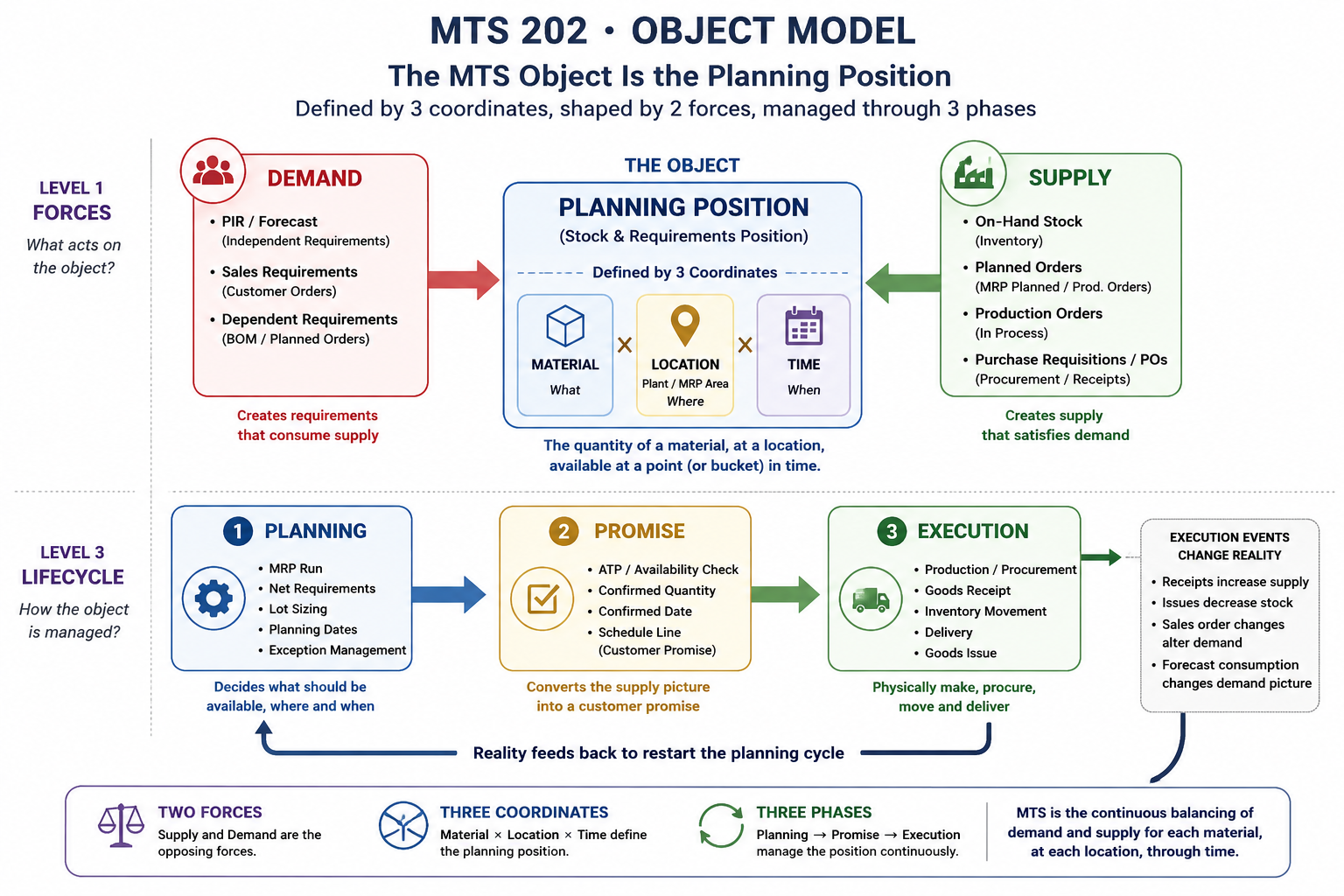
Make to Stock is organized around a planning position: the quantity of a material expected to be available at a specific location at a specific point in time. It continuously balances supply and demand through planning, promise, and execution.
READ THE MODEL
Supply and demand shape one time-phased planning position
Demand creates requirements against a material. It may come from planned independent requirements (PIRs), customer sales requirements, or dependent requirements generated through the bill of material. Supply provides the quantities that can satisfy those requirements, including on-hand inventory, planned orders, production orders, purchase requisitions, purchase orders, and expected receipts.
Neither force is meaningful on its own. A quantity only represents availability when its material, location, and time are known. One thousand units next month cannot satisfy a requirement for fifty units tomorrow. This material × location × time position is the central object of MTS.
OBJECT RESPONSIBILITY
Define the position before interpreting availability
The planning position is the intersection of three coordinates. Planning and promise decisions are only explainable when all three are explicit.
What is being planned
The material identifies the product whose stock, requirements, and replenishment proposals are being evaluated.
Where it must be available
The plant or MRP area gives the position its operational scope. Supply at another location is not automatically available here.
When it must be available
Requirements, receipts, and confirmations have dates. A future receipt cannot satisfy an earlier requirement.
What changes the position
Demand consumes availability; supply restores it. The balance remains meaningful only across the same material, location, and time.
SYSTEM BEHAVIOR
How MTS manages the planning position
The three phases repeat continuously: planning creates the supply picture, promise makes a customer commitment, and execution feeds physical reality back into planning.
Determine what should be available
MRP evaluates demand against stock and expected receipts, identifies shortages, and proposes dated supply to restore the required position.
Commit supply to the customer
ATP and availability checking translate the supply picture into confirmed quantities and dates, represented in the sales order through the schedule line.
Make the plan physical
Production, procurement, goods receipts, inventory movements, deliveries, and goods issues turn planned supply and customer commitments into reality.
Feed reality back
Receipts increase supply, issues reduce stock, customer-order changes alter demand, and forecast consumption updates the remaining demand picture.
DIAGNOSTIC EVIDENCE
Diagnose the control that owns the result
When a position is short or a promise changes, first establish the material, location, and date. Then inspect the demand and supply elements affecting that same position before assigning the cause to MRP, ATP, procurement, production, or fulfilment.
PIRs, sales requirements, dependent requirements, requested dates, forecast consumption, and remaining requirement quantities.
On-hand inventory, planned and production orders, purchase requisitions and orders, expected receipts, plant or MRP area, and dated stock/requirements elements.
ATP scope and result, confirmed schedule-line quantity and date, goods receipts, inventory movements, delivery, goods issue, and the resulting position.
PROJECT MOMENT
One material, one plant, one changing position
A fan has a June PIR at Plant A. MRP compares that requirement with Plant A stock and dated receipts, then proposes supply for the shortage. A customer order is confirmed from the available position. Production receipt raises supply, while delivery and goods issue reduce it; the next planning run evaluates the updated balance.
- Material, location, and date are explicit
- Demand and supply elements reconcile
- Schedule-line confirmation explains the customer promise
- Execution postings update the same planning position
Connect this object model to execution, accounting impact, and exception handling.