B2A 202 · OBJECT MODEL
How does an investment become an operational asset?
Trace investment approval through project and WBS control, asset under construction, settlement, final fixed assets, and the technical objects used by Operations.
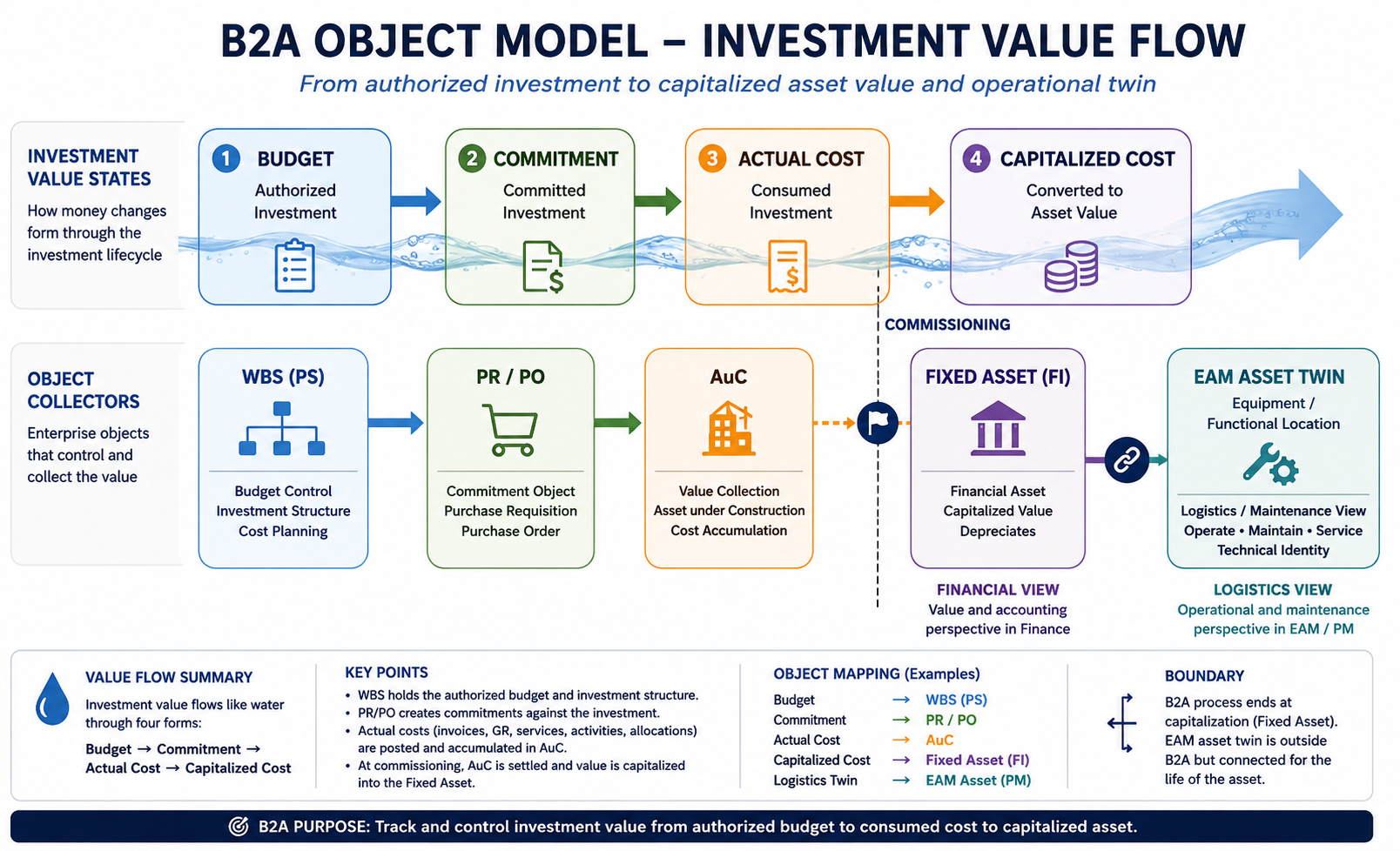
READ THE MODEL
Follow investment value from authorization to operations
Build-to-Asset is fundamentally an investment value flow. The process begins before an asset exists: with an approved investment represented as Budget, normally controlled through Project System and its WBS structure. As the investment is executed, budget becomes Commitment through purchase requisitions and purchase orders, establishing how much of the approved investment has been contracted or ordered.
As goods, services, internal activities, invoices, and other project costs are incurred, committed value becomes Actual Cost. These costs are collected against the investment structure and, for capital investment, accumulate toward the Asset under Construction (AuC). The AuC represents the financial value of the asset while it is still being built.
At commissioning, the investment crosses an important boundary. The accumulated AuC value is settled and becomes Capitalized Cost on the final Fixed Asset. What began as an approved budget has now been transformed into asset value recorded in Finance.
VALUE STATES
Keep the four forms of investment value distinct
Each value state answers a different control question during the investment lifecycle.
Budget
The approved investment authority, held against the WBS investment structure for planning and availability control.
Commitment
The contracted or ordered portion of the investment, represented through purchase requisitions and purchase orders.
Actual cost
Incurred project cost from goods, services, internal work, invoices, and other activities, accumulated in the AuC where eligible.
Capitalized cost
The settled AuC value on the final fixed asset, forming the basis for financial reporting and depreciation.
OBJECT MAPPING
Follow the value through its enterprise objects
The value flow and object model are deliberately connected: Budget → Commitment → Actual Cost → Capitalized Cost maps to WBS → PR/PO → AuC → Fixed Asset.
OPERATIONS CONNECTION
Capitalization creates a financial asset; operations can retain a technical twin
Commissioning introduces a second perspective. Finance sees the completed outcome as a Fixed Asset, while Operations may represent the same real-world asset through an EAM maintenance twin, such as Equipment and Functional Location.
EAM is not part of the B2A process itself, but it belongs in the wider object model because it shows how the asset created through B2A continues into its operational life. The financial asset carries capitalized value and depreciation; the EAM object carries the technical identity used to operate, maintain, and service the asset.
See how this capability changes across valid integration models.