CO 303 · PRACTITIONER PROCESS MAP
How does Controlling execute in SAP?
Controlling is not one linear document chain. It is a governed value flow: a source event receives a real owner, optional reporting context, allocation or settlement treatment, period-end analysis, and a decision-ready view.
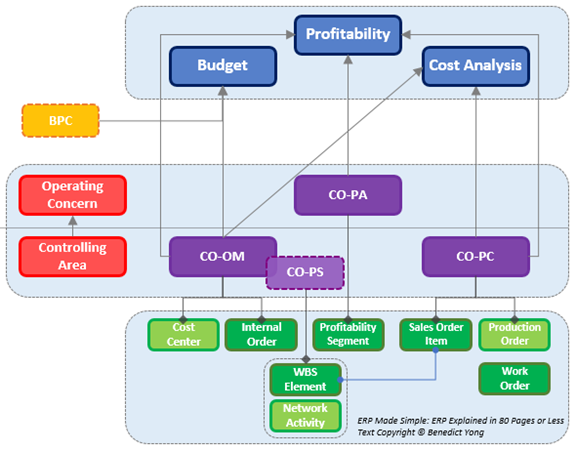
THE CO VALUE FLOW
Five steps, each with different evidence
Record the business event
Invoice, payroll, goods issue, confirmation, billing, or journal posting provides amount, quantity, date, account, and source reference.
Give the value a real owner
A cost center, order, WBS, production object, profitability segment, or other eligible object carries the real CO value.
Add reporting and causality
Statistical assignments, activity quantities, key figures, and master data supply additional context without duplicating the real cost.
Allocate, settle, and explain
Controlled cycles, WIP or results analysis where relevant, variance calculation, and settlement make shared and incomplete cost explainable.
Review the management result
Plan/actual, rate, cost, margin, and profitability reporting support a decision with a reconciled evidence trail.
EVIDENCE BY LENS
Three views should agree before action is taken
Quantity, activity, material movement, confirmation, order status, and physical completion explain what happened.
Source document, journal line, account, amount, currency, company code, profit center, and posting period explain the booked value.
Cost object, sender/receiver, driver, plan version, allocation log, settlement rule, variance, and profitability dimensions explain why the value belongs in a view.
WHEN A RESULT LOOKS WRONG
Start with the last trustworthy point
Was the source event posted with an eligible real object?
Check account behavior, posting period, source-document status, object validity, authorization, and the actual assignment before adjusting reports or allocation cycles.
Does the driver and receiver population match the rule?
Check sender balance, tracing factor, zero or missing driver data, cycle selection, period, version, run log, and reversal state.
Is the difference timing, scope, or classification?
Compare revenue, COGS, variance, WIP or results analysis, delivery, billing, settlement, and characteristic derivation before assuming Finance and CO disagree.
Turn the agreed management model into a controlled, release-aware configuration and proof scenario.